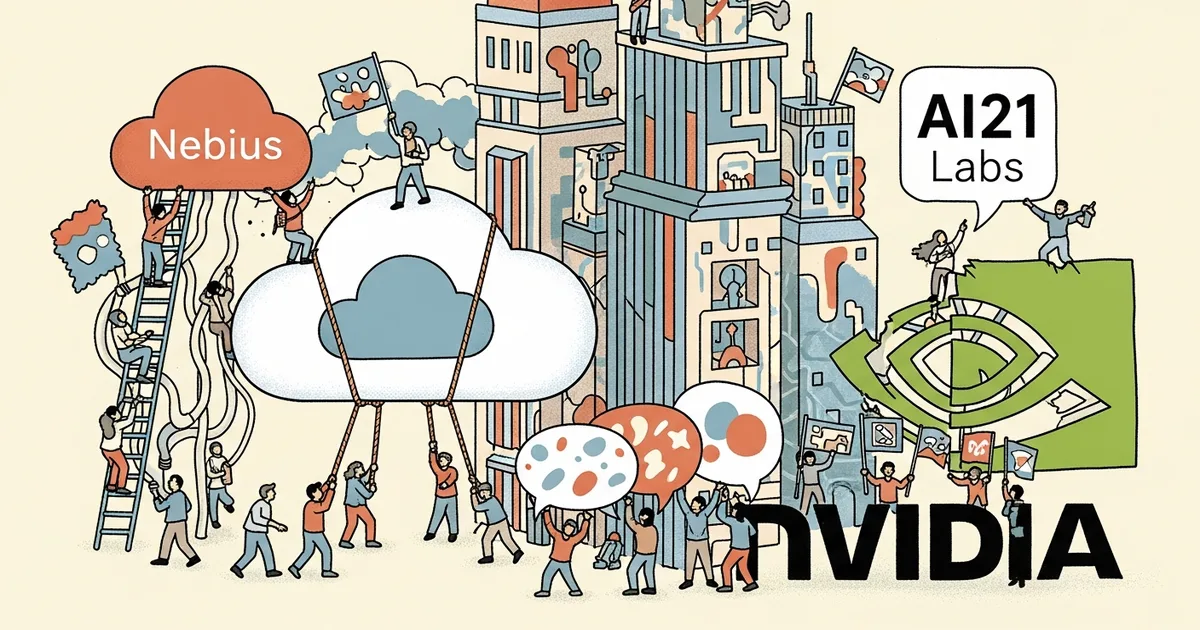
- Nebius Group, the NASDAQ-listed AI cloud infrastructure company spun out of Yandex, is in talks to acquire Israeli AI startup AI21 Labs, according to The Information.
- A previously reported acquisition deal involving Nvidia reportedly fell through before Nebius entered discussions.
- AI21 Labs, co-founded by Stanford professor Yoav Shoham and Mobileye co-founder Amnon Shashua, was last valued at approximately $1.4 billion in a 2023 Series C round.
- The potential deal would mark Nebius’s most significant move into applied AI model development since its 2024 restructuring from Yandex N.V.
What Happened
Nebius Group, the Amsterdam-headquartered AI cloud infrastructure company that trades on NASDAQ as NBIS, is in acquisition discussions with AI21 Labs, the Israeli generative AI startup known for its Jamba foundation models and Wordtune writing platform, according to a report published April 11, 2026 by The Information. The talks follow the collapse of a separate acquisition deal that had involved Nvidia, according to the same report.
The status of discussions — and whether they will result in a completed transaction — has not been confirmed publicly by either company. No financial terms have been disclosed.
Why It Matters
AI21 Labs occupies a specific niche in the generative AI market: enterprise-facing language model development with a research pedigree. The company was co-founded in 2017 by Yoav Shoham, a Stanford University computer science professor; Amnon Shashua, the co-founder and CEO of Mobileye; and Ori Goshen, who serves as co-CEO. Its 2023 Series C raised funding at a reported valuation of approximately $1.4 billion.
For Nebius, which completed its separation from Yandex N.V. in 2024 and subsequently raised a financing round of over $700 million — including a strategic investment from Nvidia — acquiring AI21 would represent a vertical expansion from cloud GPU infrastructure into proprietary model development and enterprise AI tooling.
Technical Details
AI21 Labs released Jamba in March 2024, a hybrid model architecture combining Mamba state-space model (SSM) layers with standard Transformer attention blocks. The design was positioned as a memory-efficiency improvement over pure-Transformer architectures, with the original Jamba-1.5 models supporting a 256,000-token context window — one of the larger context windows available at the time of release.
The company also develops Wordtune, a writing assistance product aimed at enterprise productivity, and operates an API platform offering access to its Jamba model family for business customers. Jamba 1.6 Mini and Jamba 1.6 Large were released in mid-2024, with the Large variant benchmarked by AI21 as competitive with models in the 70-billion-parameter class on several standard reasoning evaluations.
Nebius, for its part, operates GPU cloud clusters in Finland and the United States, with its infrastructure focused on AI training and inference workloads. The company has positioned itself as a GPU-as-a-service provider for AI developers, running Nvidia H100 and H200 hardware.
Who’s Affected
Enterprise customers currently using AI21’s Jamba API or Wordtune platform face potential uncertainty about product roadmap and pricing during any ownership transition. Competitors in the enterprise AI foundation model space — including Cohere, Mistral AI, and Writer — would observe any consolidation between an infrastructure provider and a model developer as a potential shift in how vertically integrated AI platforms compete for business contracts.
Nebius shareholders will be closely watching deal terms, particularly given that Nebius raised its 2024 capital round in part on the proposition of being a neutral infrastructure layer rather than a competing model developer.
What’s Next
The Information’s report indicates talks are ongoing, meaning no binding agreement has been announced. Either party could walk away, as reportedly occurred with the prior Nvidia discussions. AI21 Labs has not issued a public statement confirming or denying the negotiations as of April 11, 2026, and Nebius Group has not filed any transaction-related disclosures with U.S. securities regulators.
If a deal is reached, it would require regulatory review in relevant jurisdictions, including potentially in Israel given AI21’s founding location and research operations there.