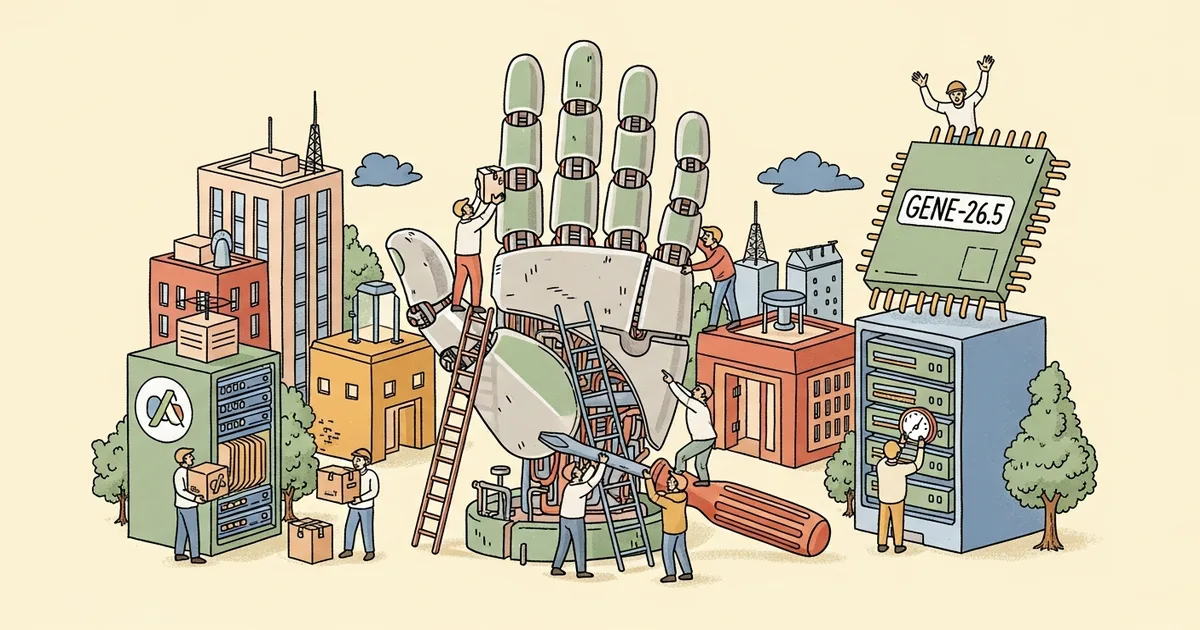
- Genesis AI unveiled its first model, GENE-26.5, on May 6, 2026 — a full-stack robotics system with custom robotic hands designed to match human-hand size and shape.
- Demos include cooking (cracking an egg, slicing a tomato), preparing smoothies, playing piano, and solving Rubik’s cube; Gervet’s favorite is cooking because it proves long-sequence task completion.
- The startup raised $105 million in seed funding in July 2025 co-led by Eclipse and Khosla Ventures, with backing from Eric Schmidt, Xavier Niel, Daniela Rus, and Bpifrance.
- Genesis also developed a sensor-loaded glove that doubles as a real-life version of its robotic hand — letting industrial workers collect training data while doing their daily jobs.
What Happened
Genesis AI unveiled its first model, GENE-26.5, on May 6, 2026, alongside custom robotic hands the company designed in-house. CEO Zhou Xian told TechCrunch the company decided to “go full stack” — building both the AI model and the hardware — after concluding that controlling the hardware was necessary to deliver the model performance the team wanted. Co-founder and president Théophile Gervet, a former Mistral AI research scientist, said cooking was his personal favorite of the showcased tasks because completing a long sequence of difficult sub-tasks proves the system’s coherence.
Why It Matters
Genesis AI’s full-stack approach — building both the foundational model and the robotic hands it controls — sits in a competitive landscape where Physical Intelligence (Pi) and Skild AI take a model-only approach with third-party hardware. Genesis’s bet is that human-form-factor hands unlock a class of training data (human videos, glove-collected data) that two-finger-gripper systems cannot use. The May 2026 release also lands in a robotics-AI moment when Meta acquired Assured Robot Intelligence for humanoid AI (May 1) and several humanoid platforms (Tesla Optimus, Figure 02, 1X Neo) are pursuing similar capabilities at higher capital intensity.
Technical Details
GENE-26.5 is named for May 2026 (Genesis Engine v26.5). The robotic hand is the same size and shape as a human hand — a deliberate departure from the two-finger grippers used by many robotics companies. CEO Zhou explained the rationale: “Our idea was that if we could design a robotic hand that tries to mimic a human hand as much as possible, we can instantly unlock huge amounts of human data without having to worry about what people call the ’embodiment gap’ in robotics research.”
Demonstrated tasks included cooking (cracking an egg, slicing a tomato), preparing smoothies, playing the piano, solving a Rubik’s cube, and lab work. Lab tasks are closer to commercial applications. Genesis has also developed a sensor-loaded glove that works as a real-life double of its robotic hand. The glove is designed to be as light and easy to wear as security gloves already used in industries — addressing the historical problem with clunky data-collection devices that get in the way.
Gervet said in customer conversations: “For the first time, you can wear the data collection device when you’re doing your daily job, whether it’s a lab technician for pharma or for manufacturing.” The company is complementing glove data with “egocentric video data” — people filming themselves doing the task. The model is already trained on “massive amounts of human-based internet videos.” Workers may opt out of sharing data, and Genesis has alternative paths via paying third-party partners.
Funding history: Genesis emerged from stealth in July 2025 with a $105 million seed round co-led by Eclipse and Khosla Ventures, with additional backers including Bpifrance, HSG, and individuals Eric Schmidt, Xavier Niel, MIT robotics professor Daniela Rus, and Vladlen Koltun. The team is 60 people split roughly 40-45% in Europe (Paris and London) and 50-55% in the U.S. (California). Hiring continues across all three locations.
Who’s Affected
Physical Intelligence and Skild AI — the model-only competitors — face a competitor with hardware integration potentially unlocking training-data sources they cannot access. The estimated 50-100 robotic-hand companies Zhou referenced face a foundation-model-aligned competitor with substantial capital. Tesla, Figure, 1X, Apptronik, and Boston Dynamics — the humanoid-robotics cohort — face a competitor pursuing a different size point (hand-first rather than full-humanoid-first). Eric Schmidt commented on the launch: “This marks an important milestone for their team and the robotics industry more broadly.” Pharma and manufacturing customers in early discussions with Genesis gain a robotics deployment option specifically built around their existing safety-glove workflows.
What’s Next
Genesis plans to reveal its first general-purpose robot shortly — a full-body system, not just hands, per Zhou. The roadmap remains the same: “build the most capable robotic system.” Watch for early customer announcements in pharma and manufacturing labs, the most plausible commercial deployment categories given the demoed task profile. Independent verification of the GENE-26.5 task completion claims — particularly the cooking sequence — will likely surface in third-party robotics evaluations over the next several months.