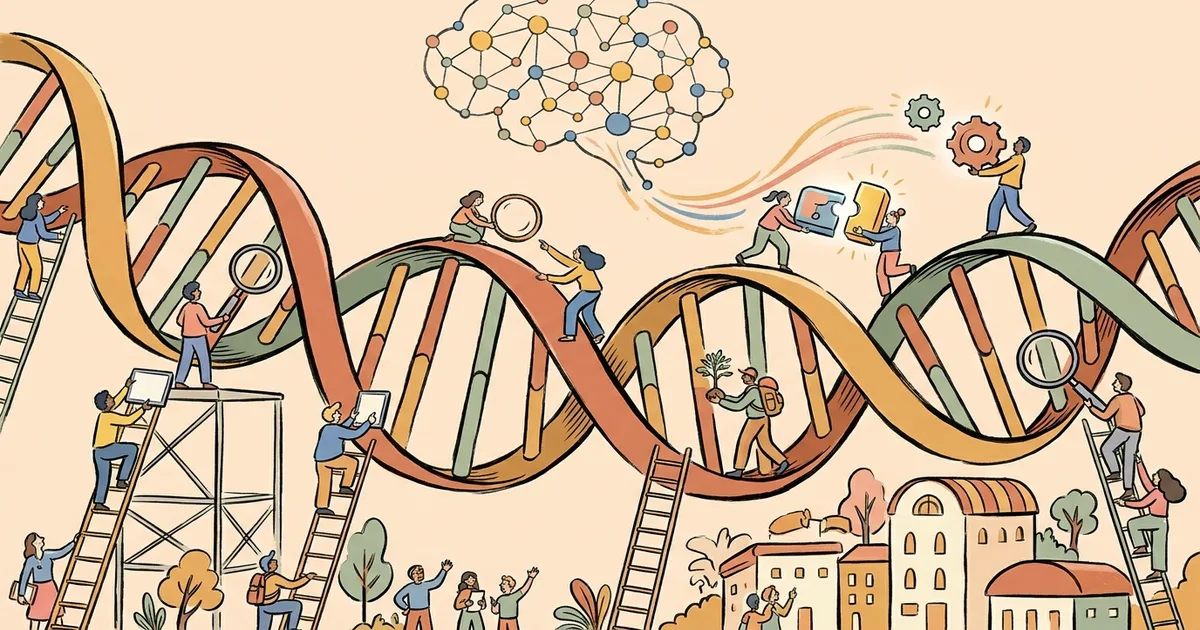
- Google DeepMind built an AI model that predicts the effects of about 9 billion DNA changes.
- The goal is to help researchers find the genetic causes of diseases.
- It extends DeepMind’s biology work beyond protein structure into genomics.
- Predictions still require experimental validation before clinical use.
What Happened
Google DeepMind has used AI to predict the effects of roughly 9 billion possible DNA changes, in a model the lab hopes will help researchers find the secrets to ailments, Bloomberg reported on September 9, 2026. The work applies DeepMind’s modeling approach to the genome at a scale that would be impractical to test experimentally.
Why It Matters
Most genetic variants sit in regions whose function is poorly understood, and distinguishing harmful mutations from benign ones is a central bottleneck in disease research. DeepMind previously reshaped structural biology with AlphaFold, which predicted the shapes of hundreds of millions of proteins and earned a share of the 2024 Nobel Prize in Chemistry. A comparable resource for DNA variants could narrow the search space for the causes of inherited disease.
Technical Details
Predicting the effect of 9 billion changes means scoring, computationally, how single-letter and larger DNA edits alter biological function across the genome. Such predictions are hypotheses to be tested, not diagnoses: the value is in ranking which variants are most likely to matter so wet-lab experiments can focus on them. Accuracy varies by genomic region and by the type of change.
Who’s Affected
Geneticists, rare-disease researchers, and drug-discovery teams are the direct beneficiaries of a large variant-effect atlas. Patients stand to gain only after predictions are experimentally confirmed and translated into clinical tools, a multi-year path.
What’s Next
The practical test is whether the predictions hold up against laboratory results and existing clinical databases. DeepMind has historically released such datasets to researchers, which would let independent groups gauge the model’s reliability.