Peter Thiel’s Founders Fund is leading a new funding round for Halter, an Auckland-based startup that makes AI-powered cow collars, at a pre-money valuation of approximately $2 billion. The deal, first reported by Bloomberg on March 20, follows a $100 million round at roughly $1 billion valuation in June 2025 led by BOND.
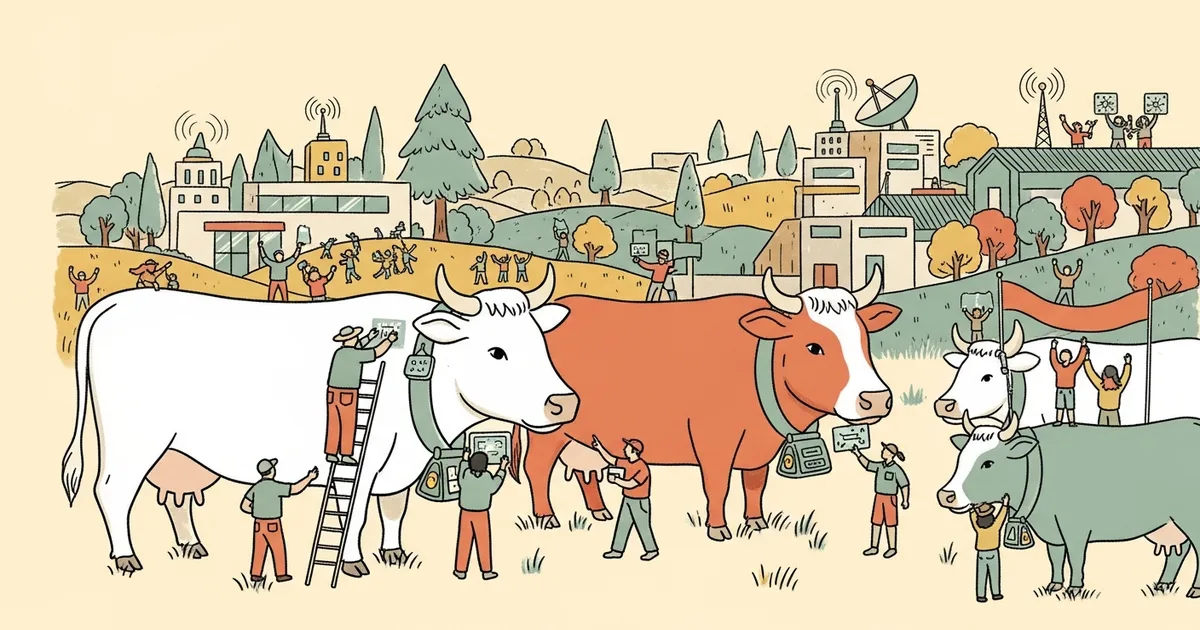
Founded in 2016 by Craig Piggott, Halter builds solar-powered, GPS-enabled collars that create virtual fences, monitor cattle location and health indicators, and herd animals using vibrations and audio cues — all controlled through a mobile app. The company has deployed nearly 700,000 collars across New Zealand, Australia, and 22 U.S. states, managing operations for approximately 1,300 dairy and beef farms. Pricing starts at NZ$9.90 (roughly $5.70 USD) per collar per month.
Investors are framing Halter not as a virtual fencing company but as a digital operating system for farms and ranches. Each collar functions as an autonomous physical AI agent, collecting continuous data on animal movement, health, and behavior. The company’s internal team has developed machine learning algorithms they call “cowgorithms” — models trained to predict disease onset and peak mating times from collar sensor data. This positions Halter at the intersection of two investment themes: autonomous AI agents operating in physical environments, and the digitization of a cattle-products market estimated at over $1 trillion annually.
The $2 billion valuation places Halter in rare company among agricultural technology startups and reflects broader venture capital enthusiasm for AI applications outside traditional software. The deal signals that investors see physical-world AI deployment — where autonomous agents operate continuously in unstructured environments — as a category with defensible unit economics and high switching costs. A farmer with 700 collars generating daily data streams has strong incentives to stay on the platform.
Halter’s next phase will likely focus on expanding its U.S. footprint, where beef operations are significantly larger than the dairy farms that dominate its New Zealand base. The company will also need to demonstrate that its health-prediction models deliver measurable outcomes at scale — a step that separates agricultural AI companies with durable value from those riding a funding cycle.