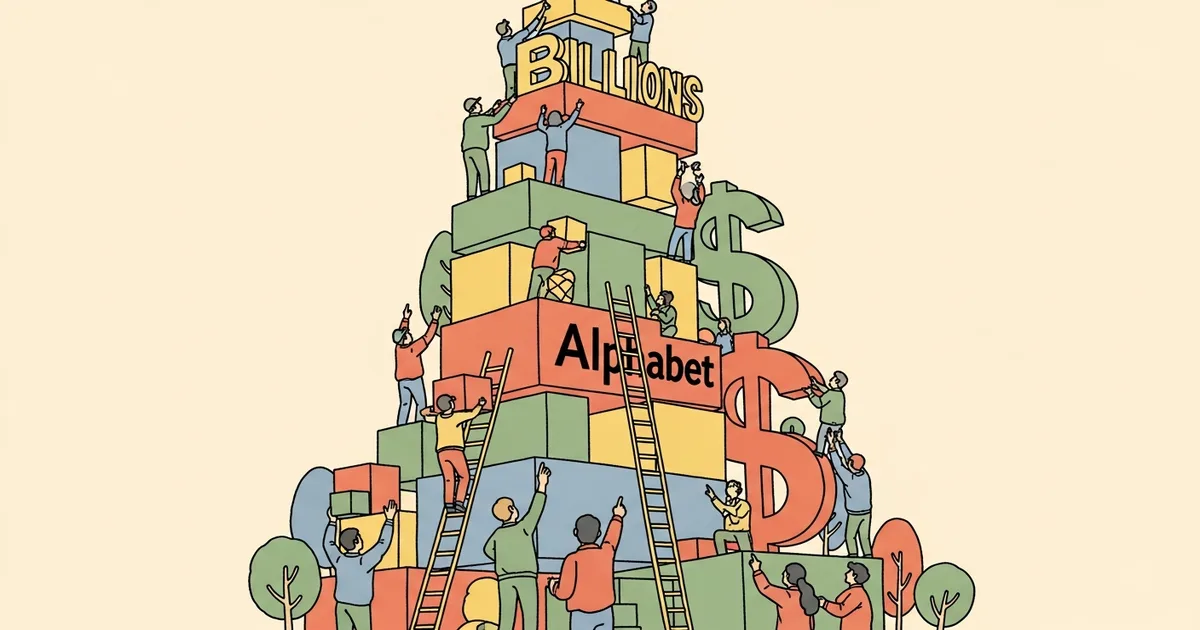
- Alphabet raised 2026 capex guidance to $195–$205 billion, up from $180–$190 billion a quarter earlier, and said 2027 spending will “significantly increase” from there.
- Q2 capital expenditure was $44.9 billion; free cash flow was negative $5.9 billion for the quarter.
- Google Cloud revenue rose 82% year over year to $24.8 billion, with cloud backlog up more than $50 billion sequentially to $514 billion.
- Total Q2 revenue was $119.8 billion, up 24%, but the stock fell after hours on the spending guidance.
What Happened
Alphabet raised its 2026 capital expenditure guidance to between $195 billion and $205 billion, up from the $180–$190 billion range issued a quarter earlier, when it reported second-quarter results on July 22, 2026. Bloomberg reported that the target reignited concerns about fiscal discipline in the race to dominate AI, and the shares fell after hours despite a revenue beat.
The quarter itself was strong on the top line: revenue of $119.8 billion, up 24% year over year, with Google Cloud up 82% to $24.8 billion. The friction is entirely on the cash side — capital expenditure of $44.9 billion in the quarter pushed free cash flow to negative $5.9 billion.
Why It Matters
A $15 billion upward revision to annual guidance in a single quarter is not a rounding adjustment; it signals that demand is running ahead of the capacity Alphabet planned for six months ago. CFO Anat Ashkenazi said the company is “still in a supply-constrained environment,” and that Alphabet will lean on third-party capacity as a bridging strategy in the third quarter — an unusual admission from a company that operates its own data centers and designs its own TPUs.
The market’s discomfort is with the shape of the return, not the demand. Negative free cash flow at a company that has generated tens of billions of dollars of it per quarter marks the point where the AI buildout stops being funded out of surplus. Alphabet’s guidance that 2027 capex will rise “significantly” from a $205 billion base extends that condition into next year.
Technical Details
Segment detail: Search and other revenue grew 17%, YouTube advertising 13%, and Google Cloud 82%. Cloud backlog — contracted revenue not yet recognized — climbed by more than $50 billion sequentially to $514 billion, which is the strongest available evidence that the capacity being built has committed buyers behind it.
CEO Sundar Pichai defended the outlay in terms of deal lifetime rather than quarterly cost, saying the incremental opportunity customers bring “while a short-term cost over a few months may be very high, in the lifetime of the deal, as we bring more capacity on, is highly ROI positive.” He also said the company is “in very early innings of what feels like a secular shift” and that “if anything, over the past year, we’ve gotten more bullish on the opportunities ahead.”
The distinction that matters for anyone modelling this: the $514 billion backlog is contracted, while the $195–$205 billion capex figure is committed spend. The first converts to revenue on a schedule set by delivered capacity; the second is being spent now.
Who’s Affected
Nvidia, AMD, Broadcom, and the data-center construction and power supply chains are the direct beneficiaries of the revision — an extra $15 billion of guided spend flows largely to them. Google Cloud customers get the capacity relief that the supply-constraint comment implies is currently rationed.
Alphabet shareholders absorb the timing mismatch. The same question is being put to Microsoft, Amazon, and Meta this earnings season, and Alphabet’s negative free cash flow quarter sets a marker for how far a hyperscaler is willing to run cash-flow negative to hold its position.
The advertising business is the quieter dependency. Search grew 17% and YouTube 13% — healthy, but nowhere near enough on their own to absorb a $205 billion capital program, which means the buildout is being financed against cloud and AI revenue that is still a minority of group turnover. Any deceleration in the 82% cloud growth rate changes the arithmetic quickly.
What’s Next
Ashkenazi’s third-quarter bridging plan means Alphabet will be renting capacity it would prefer to own, so the Q3 report is where the supply constraint either eases or hardens. The 2027 guidance is directional rather than quantified, and Alphabet has not committed to a number — which leaves the actual test of the “highly ROI positive” claim to whether cloud revenue growth holds near current rates as the backlog converts.
Related Reading
- Glow Exits Stealth at $1.2B to Rebuild Endpoint Security for AI
- Judge grants final approval to Anthropic’s $1.5B copyright settlement
- How Google’s New Gemini Usage Limits Work, and How to Check Yours
- OpenAI Hires for Families as ChatGPT’s Over-35 Audience Grows
- Bridgewater Fine-Tunes Qwen3-235B to Beat GPT and Claude on Finance