Key Takeaways
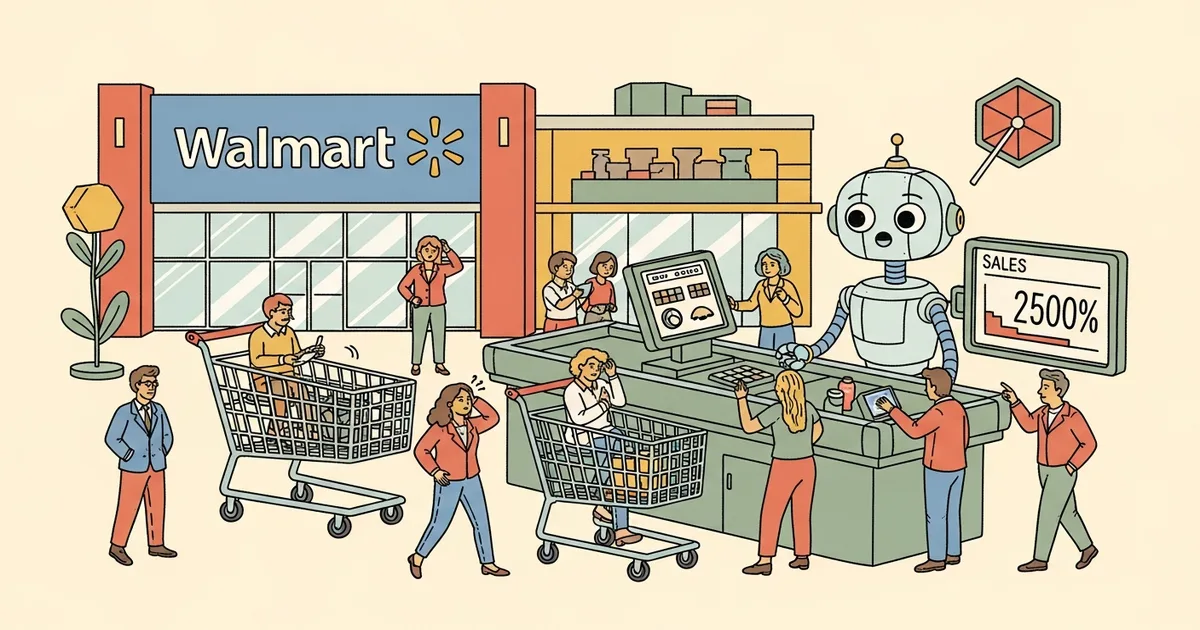
- Walmart reported that purchases completed inside ChatGPT‘s Instant Checkout converted at one-third the rate of transactions where users clicked out to Walmart.com.
- The retailer is replacing Instant Checkout with its own chatbot, Sparky, embedded inside ChatGPT, which already shows 35% higher average order values than non-Sparky sessions.
- Shopify launched Agentic Storefronts on March 24, 2026, but adopted a redirect-to-merchant checkout model rather than in-chat purchasing.
- The data suggests AI can accelerate product discovery but cannot yet replace the full shopping and checkout experience.
What Happened
Walmart’s executive vice president of product and design, Daniel Danker, disclosed that conversion rates for products sold through OpenAI’s Instant Checkout inside ChatGPT were three times lower than products that required users to click out to Walmart’s own website. Danker called the in-chat buying experience “unsatisfying” and confirmed Walmart is moving away from it.
The retailer had offered roughly 200,000 products through Instant Checkout since November 2025. Each product recommended by ChatGPT triggered its own individual transaction, with separate shipping calculations and delivery timelines. That single-item purchase model made it impossible for shoppers to build carts, compare options, or apply existing Walmart+ benefits.
Why It Matters
This is the first major retailer to publish hard conversion data from AI-native checkout. The result undermines the assumption that keeping users inside a chat window produces better outcomes than redirecting them to a traditional storefront. It arrives at a critical moment: Shopify launched Agentic Storefronts on March 24, 2026, connecting every Shopify merchant to ChatGPT, Microsoft Copilot, Google AI Mode, and Gemini. Shopify, notably, chose a redirect model from the start rather than in-chat checkout.
OpenAI had been running Instant Checkout since January 2026, charging merchants a 4% fee on every in-chat sale stacked on top of standard processing costs. Onboarding was slow: roughly 30 Shopify merchants were available via Instant Checkout as of last month. OpenAI has since retreated from that model under merchant pressure.
Technical Details
Walmart’s Instant Checkout operated as a single-SKU transaction layer. Each product surfaced by ChatGPT generated an independent purchase event with its own payment authorization, shipping calculation, and fulfillment routing. There was no cart aggregation, no Walmart+ membership integration, and no ability to apply store-level promotions or bundle discounts.
The replacement system embeds Walmart’s proprietary chatbot, Sparky, directly inside ChatGPT. Users authenticate with their Walmart credentials, which syncs cart data, Walmart+ status, and purchase history across both platforms. Walmart US CEO David Guggina disclosed during the company’s Q4 earnings call that Sparky users carry an average order value approximately 35% higher than non-Sparky customers. A similar integration is planned for Google Gemini.
Shopify’s Agentic Storefronts take a different architectural approach. Rather than completing transactions inside the chat window, AI qualifies the buyer through conversation and then redirects them to the merchant’s own checkout. This preserves post-purchase upsell tools, loyalty integrations, and standard payment processing fees without the added 4% OpenAI surcharge.
Who’s Affected
Retailers evaluating AI commerce channels now have a concrete benchmark: in-chat checkout converts at roughly one-third the rate of click-out. Shopify’s 2 million-plus merchants are affected by the design choice Shopify made on their behalf, opting for redirect checkout over in-chat purchasing. Brands that invested in OpenAI’s Instant Checkout program face a pivot, and those paying the 4% surcharge on an already-low-converting channel may have been losing money on each AI-sourced transaction.
Consumers also lose a frictionless experience in theory, but the data shows they were not using it effectively in practice. The inability to build multi-item carts, apply membership benefits, or compare shipping options made the in-chat experience worse than the standard website flow.
What’s Next
Walmart expects to roll out the Sparky integration inside ChatGPT in the coming weeks, with Gemini following shortly after. The key metric to watch is whether the authenticated, cart-syncing approach closes the conversion gap between AI-initiated and website-initiated purchases. Gap is testing a different approach entirely: its AI integration in ChatGPT currently uses a click-out model that sends shoppers directly to Gap.com to complete purchases, betting that AI works best as a discovery layer rather than a transaction layer.
OpenAI still needs to prove that agentic commerce can sustain a viable business model. With Instant Checkout abandoned and the 4% fee dropped, the company’s monetization path for shopping inside ChatGPT remains undefined.