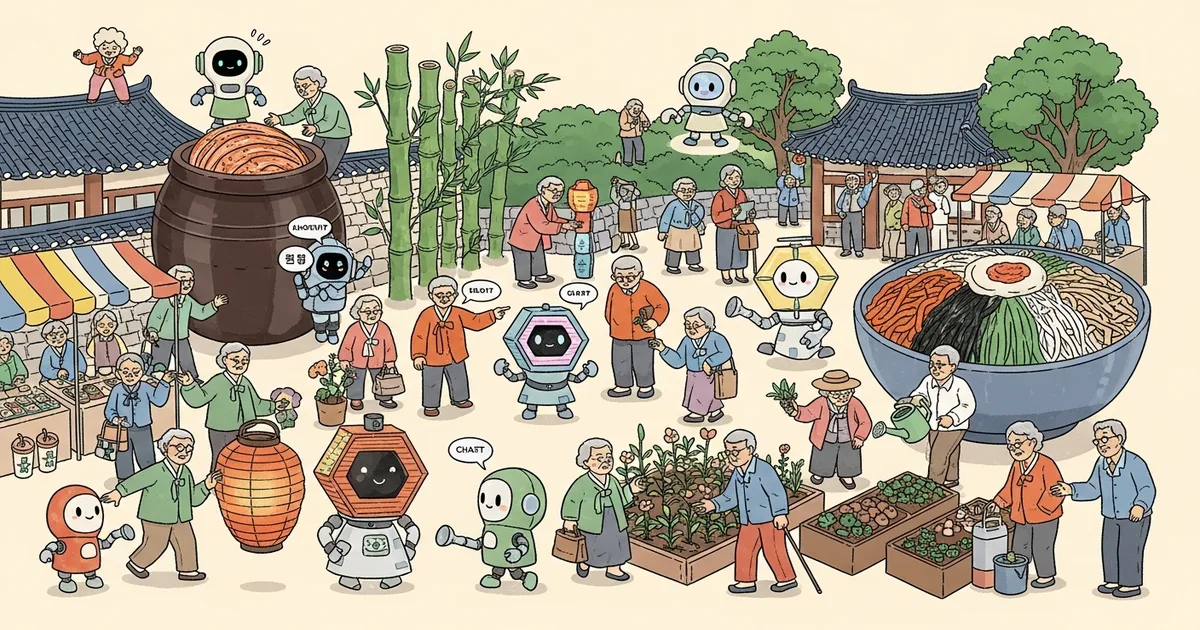
South Korea’s government, as reported by the Financial Times in April 2026, is deploying thousands of ChatGPT-powered social care robots to elderly citizens — making it the largest state-run rollout of south korea ai elderly robots anywhere in the world. The program arrives as South Korea crosses a historic demographic threshold: over-65s now constitute roughly 20% of the country’s 51 million people, or approximately 10.2 million individuals living inside a social care system not built to serve this many of them.
This is not a pilot program. It is a national policy response to a demographic emergency, and it represents one of the clearest real-world deployments of large language model technology into state welfare systems to date.
What the Robots Actually Do
The robots are not androids. They are purpose-built companion devices — typically tabletop or mobile units — running ChatGPT-backed conversational AI that allows them to hold natural-language conversations with elderly users. The capabilities are functional rather than theatrical:
- Medication reminders: Scheduled prompts tied to prescription regimens
- Emergency detection and alerts: Monitors for falls or lack of movement and contacts family or emergency services
- Daily conversation: Open-ended dialogue to reduce social isolation
- Health check-ins: Basic wellness questions logged and, in some implementations, relayed to caregivers
The conversation layer is the key differentiator from earlier generations of care-alert devices. A device that merely detects falls is a sensor. A device that can discuss last night’s news, remember your grandchildren’s names, and ask how your knee is feeling is something closer to a persistent social presence — which is precisely what makes it useful, and precisely what makes it ethically complicated.
The Demographic Crisis Behind the Decision
South Korea’s aging curve is among the steepest in the developed world. The country’s total fertility rate fell to 0.72 in 2023 — the lowest of any OECD nation and roughly one-third the replacement rate of 2.1. The consequence is a double compression: the elderly population is growing rapidly while the working-age population that funds and staffs the care system is shrinking in parallel.
Government projections indicate demand for residential and in-home care will outpace supply by the early 2030s without structural intervention. Deploying AI companions is partly cost mitigation, partly bridge technology — a way to extend the reach of an already-strained care workforce without proportionally expanding it.
The demographic math is not unique to South Korea. Japan crossed the 20% elderly threshold in 2006 and now sits at roughly 30%. Germany, Italy, and several EU nations face comparable trajectories over the next decade. As OpenAI’s commercial partnerships continue expanding into unexpected sectors — including its $1 billion Disney deal — the Korean rollout may represent the opening move in a broader competition to supply AI infrastructure to aging-nation governments.
The Ethics of Replacing Human Contact with AI
The Humans First movement has raised consistent objections to AI substitution in caregiving contexts, and those objections are not frivolous. The core concern: that deploying AI companions reduces political pressure to invest in human caregiving infrastructure, normalizing underfunded care as acceptable so long as a robot is present.
A separate empirical argument cuts the other way. Social isolation in elderly populations is associated with a 26% increased risk of dementia and a 29% increased risk of heart disease, according to the U.S. Centers for Disease Control. If AI conversation mitigates isolation even partially, there is a measurable public health benefit. If it substitutes for human contact rather than supplementing it, the benefit is far less clear.
South Korea’s deployment has not published a randomized trial. It has published a policy. The distinction matters enormously. Health outcomes will only become visible over years of operation, and by the time data arrives, the infrastructure will be deeply embedded in the welfare system — which is precisely when it becomes hardest to course-correct.
The Cost Calculus
Professional in-home elderly care in South Korea costs roughly ₩20,000–₩30,000 per hour (approximately $15–$22 USD) for baseline services. A social care robot, amortized over a three-to-five year lifespan with software subscription costs, runs substantially less per day of coverage — particularly during overnight and weekend hours when human staffing is most expensive and hardest to source.
Analogous commercial companion robots in South Korea and Japan — including Softbank’s Pepper and SKT’s NUGU-based products — have historically retailed in the ₩2–5 million range ($1,500–$3,700) before government volume discounts. With ChatGPT API costs declining as OpenAI scales capacity, the per-interaction cost of AI conversation is approaching fractions of a cent per exchange.
This is where the economic logic becomes structurally difficult to resist, regardless of ethical preferences. AI conversation is not just cheaper than human labor — it is available at 3 a.m., does not call in sick, and does not require pension contributions. Governments with strained budgets will find this argument increasingly hard to decline.
Will This Become a Global Model?
The short answer is yes, with variation by income level and technological infrastructure. South Korea’s deployment works because the country has high broadband penetration among elderly users, a well-documented culture of rapid technology adoption, and a government with the administrative capacity to execute large-scale welfare programs quickly.
Japan has been running smaller companion robot programs since 2015, most notably with PARO — the therapeutic seal robot developed by the National Institute of Advanced Industrial Science and Technology — now deployed in over 30 countries. But PARO predates LLMs and cannot hold a conversation. The ChatGPT integration South Korea is scaling changes the utility ceiling substantially. Autonomous AI systems operating in physical environments are maturing quickly, and elderly care is emerging as one of the earliest commercially viable applications at national scale.
European governments are watching. The EU’s AI Act, which came into force in 2024, classifies AI systems used in care contexts as high-risk — requiring conformity assessments and mandated human oversight provisions. A large-scale Korean deployment producing measurable outcome data will either accelerate or complicate European adoption depending on what those outcomes show. The data South Korea generates over the next 24 months will effectively set the global policy template.
The Limits of What ChatGPT Can Actually Do
ChatGPT is a language model. It generates contextually appropriate text responses. It is not a licensed medical device, a therapist, or a substitute for a physician. The risk profile in the Korean deployment is specific and non-trivial:
- A user disclosing suicidal ideation to a system not equipped to escalate appropriately
- Medication reminders that cannot account for a physician changing a prescription mid-cycle
- Emergency detection that fails in ambiguous edge cases — a user sitting motionless who is meditating, not unconscious
- Conversational reinforcement of false or confused beliefs in users with early-stage dementia
None of these failure modes are reasons not to deploy the technology. They are reasons to deploy it with human oversight layers, clearly defined escalation paths, and continuous monitoring. MegaOne AI tracks 139+ AI tools across 17 categories, and the pattern across high-risk deployments is consistent: governance infrastructure lags the technology by 18–24 months. South Korea’s program, moving at national speed, is at high risk of this gap.
What South Korea Gets Right — and Where the Risk Lies
The Korean government is not framing this as a cost-cutting exercise dressed as a care program. The deployment explicitly targets the hardest-to-reach population: elderly people living alone in rural and semi-rural areas where visiting care workers are logistically expensive and unavailable outside business hours. That targeting reflects the right instinct.
AI companion technology is most defensible when it fills genuine voids — hours no human caregiver would otherwise cover, conversations no family member is available to have — rather than displacing contact that would otherwise exist. AI is integrating into daily infrastructure across sectors at an accelerating rate, and elderly care, with its clear need and measurable outcomes, is where that integration becomes most consequential and most contested.
Whether deployment discipline holds as budget pressures mount is the central question. The pattern in social welfare programs globally is that targeted pilot logic erodes under fiscal pressure — what begins as supplementary coverage becomes substitutive coverage when governments need to cut spending. South Korea’s demographic crisis is real enough that the pressure will be intense.
For policymakers in aging nations watching this rollout: the question is no longer whether to deploy AI in elderly care. The Korean precedent makes the question unavoidable. The only remaining decision is whether to deploy it with governance infrastructure capable of catching failures — or to ship the robots and address the consequences later, which is historically how these programs go.