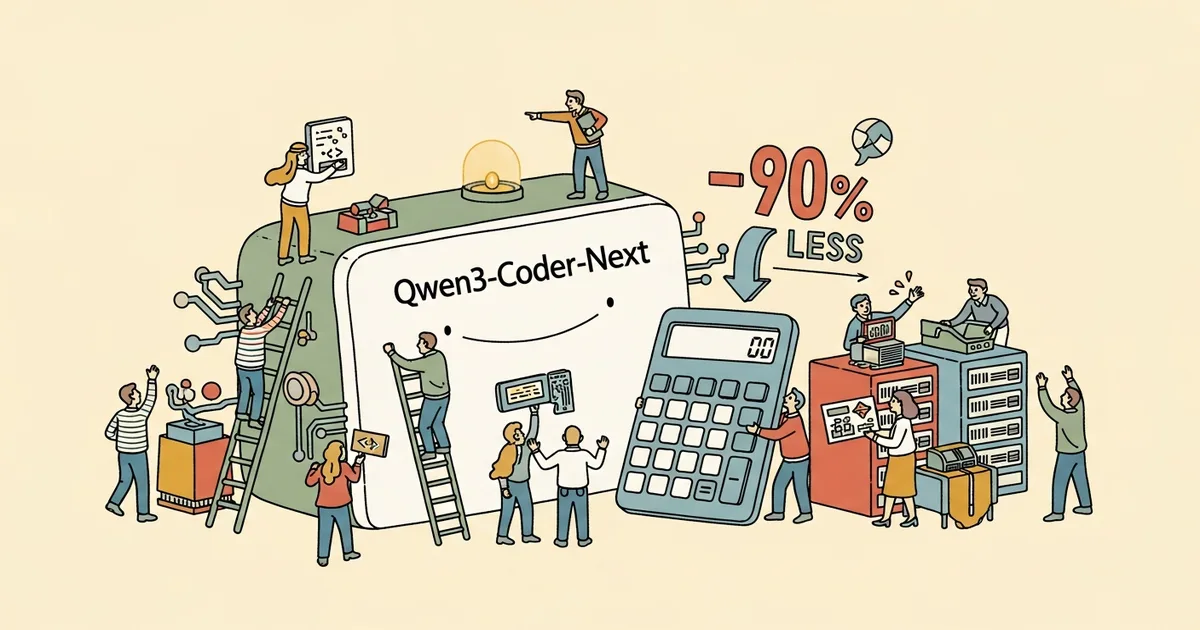
Key Takeaways
- Qwen3-Coder-Next is an open-weight coding model with 80 billion total parameters but only 3 billion active per token, achieving 70.6% on SWE-Bench Verified.
- API pricing starts at $0.12 per million input tokens — roughly 95% cheaper than GPT-5.4’s $2.50 per million input tokens.
- The model supports 370 programming languages with a 256K context window, extendable to 1M tokens for large codebases.
- Released under Apache 2.0, Qwen3-Coder-Next runs locally on consumer hardware including a 64GB MacBook.
What Happened
Alibaba’s Qwen team released Qwen3-Coder-Next in February 2026, an open-weight coding model built specifically for AI agent workflows. The model is based on Qwen3-Next-80B-A3B-Base and uses a sparse Mixture-of-Experts (MoE) architecture that activates only 3 billion of its 80 billion total parameters on each forward pass. Despite this extreme sparsity, it scores 70.6% on SWE-Bench Verified using the SWE-Agent scaffold — competitive with models that use 10 to 20 times more active parameters.
The release is available on Hugging Face and ModelScope under the Apache 2.0 license. Jinze Bai, a lead researcher on the Qwen team at Alibaba Group, was among the first authors on the original Qwen technical report that laid the foundation for this series.
Why It Matters
Qwen3-Coder-Next represents a broader shift in the AI industry toward task-specific models that trade raw parameter scale for inference efficiency. While frontier general-purpose models like GPT-5.4 ($2.50 per million input tokens, $15.00 per million output tokens) and Claude Opus 4.6 ($5.00/$25.00 per million tokens) continue to lead overall benchmarks, the cost gap has become difficult to justify for routine coding tasks.
At $0.12 per million input tokens and $0.75 per million output tokens, Qwen3-Coder-Next costs roughly 95% less than GPT-5.4 on input and 95% less on output. For a developer running 100 API requests per day at 2,000 tokens each, that translates to approximately $2.10 per month versus $15.00 for GPT-5.4 — a difference that compounds across engineering teams.
Technical Details
The architecture combines hybrid attention mechanisms with MoE routing. Alibaba’s team trained the model on 800,000 verifiable coding tasks using what they describe as “large-scale executable task synthesis, environment interaction, and reinforcement learning.” Rather than scaling parameters, the team scaled agentic training signals — the model learns directly from environment feedback during code execution.
Benchmark results tell a nuanced story. On SWE-Bench Verified, Qwen3-Coder-Next scores 70.6%, compared to Claude Opus 4.6 at 80.8% and Claude Code at 80.9%. On SWE-Bench Pro, a harder subset, it reaches 44.3% — comparable to Claude Sonnet 4.5 despite using a fraction of the compute. It also scores 62.8% on SWE-Bench Multilingual, reflecting its expanded language support: 370 programming languages, up from 92 in the Qwen2.5-Coder series.
The model’s context window is 256K tokens by default, extendable to 1M tokens for processing large repositories. Throughput is another advantage: at 161 tokens per second, it outpaces GPT-5.4’s 77 tokens per second by more than 2x, according to comparative benchmarks on LLM Base.
Who’s Affected
Cost-conscious development teams and solo developers stand to benefit most. XDA Developers tested Qwen3-Coder-Next against four other local coding models and called the performance gap “embarrassing” — the model resolved a PyYAML date-parsing issue faster than any competitor, completing the task in 17 minutes with 16 passing tests on its second attempt. “It was the only model that actually read the PyYAML docs,” the reviewer noted.
The model runs locally on consumer hardware. A 64GB MacBook can handle the 4-bit quantized version, which requires approximately 46GB of unified memory. For teams concerned with code privacy or operating in air-gapped environments, local deployment eliminates the need to send proprietary code to external APIs. OpenAI’s Codex and Anthropic’s Claude Code remain stronger on complex multi-step reasoning tasks, but for straightforward code generation, debugging, and repository-level operations, Qwen3-Coder-Next closes much of that gap at a fraction of the cost.
What’s Next
The Qwen team has signaled continued investment in sparse MoE architectures for domain-specific tasks. The model is already available through OpenRouter, Ollama, and LM Studio for local deployment. A key limitation remains: on intelligence-heavy benchmarks that test abstract reasoning beyond code, GPT-5.4 scores 57.2 versus Qwen3-Coder-Next’s 28.3, suggesting the model’s narrow specialization comes with clear trade-offs. For teams that need a fast, cheap, and capable coding agent — and are willing to accept those trade-offs — Qwen3-Coder-Next is the strongest open-weight option available.