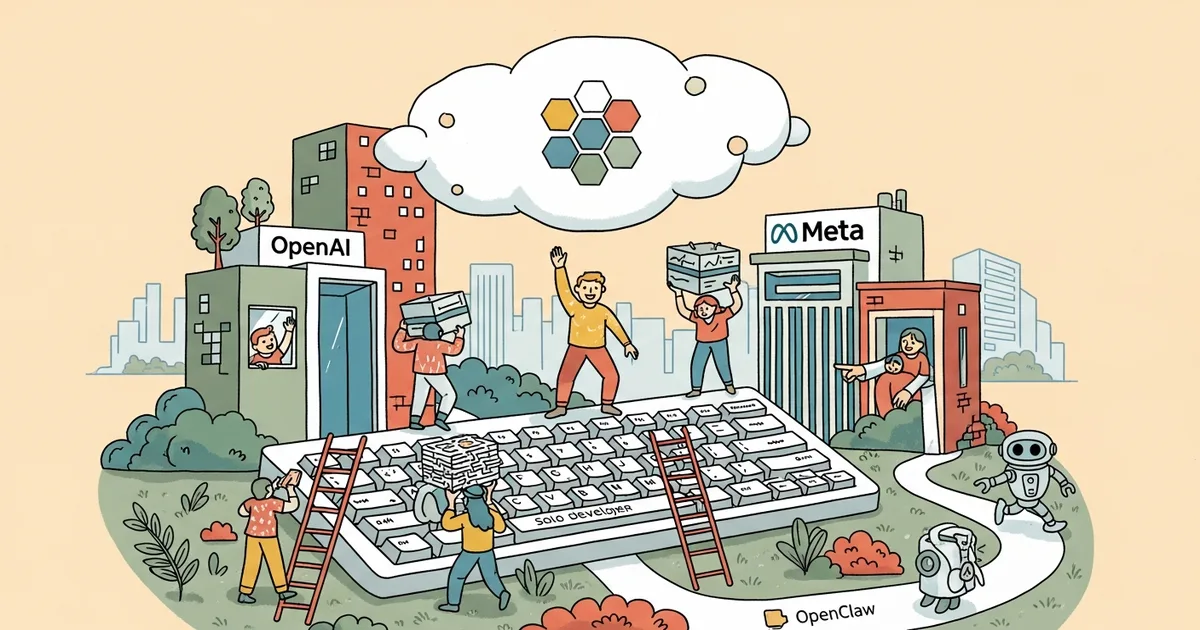
- Peter Steinberger, creator of the open-source AI agent tool OpenClaw, was acqui-hired by OpenAI after building the project as a solo “playground” effort over two months.
- Meta and Microsoft both courted Steinberger, with Microsoft CEO Satya Nadella reportedly calling him directly.
- OpenClaw will transition to an independent open-source foundation under the MIT license, which was Steinberger’s non-negotiable condition.
- The deal is an acqui-hire, not an acquisition: OpenAI hired the person, not the company or the product.
What Happened
Peter Steinberger, a veteran software developer with 13 years of experience running his own company, announced that he is joining OpenAI to “work on bringing agents to everyone.” The move followed weeks of courtship from multiple AI labs after his solo project, OpenClaw, gained rapid adoption among developers in late 2025 and early 2026.
Steinberger built OpenClaw as what he described as a “playground project” after pivoting from his previous company to explore AI agents. Released in November 2025, the open-source tool saw a “hockey stick” adoption curve through December 2025 and January 2026, attracting developers and so-called “vibe coders” who were impressed with its ability to execute multi-step tasks autonomously without constant human supervision.
OpenAI, Meta, and Microsoft all approached Steinberger with offers. Microsoft CEO Satya Nadella reportedly called him directly to make the company’s pitch. Steinberger chose OpenAI because the company agreed to keep OpenClaw open-source, a condition he described as non-negotiable. He explained his decision by saying: “The more I talked with the people there, the clearer it became that we both share the same vision.”
Why It Matters
The deal illustrates a recurring pattern in AI: large companies acquiring talent rather than technology. OpenAI did not buy OpenClaw the product. It hired Steinberger the person. The distinction matters because OpenClaw will continue to exist as an independent project under a foundation structure with an MIT license, meaning the code remains freely available to the developer community.
According to VentureBeat’s analysis, what OpenAI acquired was operational experience in building agent infrastructure that developers actually adopt voluntarily. Steinberger had demonstrated something that the major AI labs have struggled with: creating an agent tool that gained grassroots traction among working developers rather than requiring top-down enterprise sales.
The fact that a single developer’s side project attracted direct attention from the CEOs of three of the largest technology companies signals how much value the industry places on practical agent infrastructure. OpenClaw’s appeal was not its model or its data but its ability to orchestrate AI agents in ways developers found immediately useful for real-world coding and automation tasks.
Technical Details
OpenClaw is an open-source AI agent framework that allows developers to deploy, manage, and coordinate autonomous agents. The tool gained traction specifically among developers building agentic workflows, where AI systems execute multi-step tasks, such as writing code, running tests, and debugging errors, without continuous human oversight between each step.
The project was built and maintained by Steinberger alone over roughly two months of development. Despite its solo origin, OpenClaw reached an adoption scale that caught the attention of major AI labs. Reports reference millions of agents deployed through the platform, though exact user numbers have not been publicly confirmed by Steinberger or an independent source.
Under the foundation model, OpenClaw will remain MIT-licensed and will expand to “support even more models and companies,” according to Steinberger’s announcement. OpenAI will sponsor the project financially, and Steinberger will dedicate time to maintaining it alongside his primary work at OpenAI on the company’s agent products.
Who’s Affected
Developers currently using OpenClaw retain full access to the tool under its open-source license. The transition to a foundation structure should provide more organizational stability than a single-maintainer project, though the quality of governance will depend on how the foundation is managed and whether additional core maintainers are recruited.
OpenAI gains operational experience in agent infrastructure, which is where Steinberger’s primary value lies. The company’s existing agent products, including its Assistants API and GPTs, may benefit from the practical insights Steinberger brings from building a tool that developers adopted voluntarily and at scale without marketing spend.
Meta and Microsoft lost the hire. For Microsoft specifically, the loss is notable given its multi-billion-dollar investment in OpenAI and its own Copilot agent strategy. Having the OpenClaw creator working inside a company Microsoft partially owns, rather than directly for Microsoft itself, creates an unusual competitive dynamic.
What’s Next
The OpenClaw foundation has not yet published its governance structure or named additional maintainers beyond Steinberger. Whether the project sustains its development momentum after Steinberger shifts his primary focus to OpenAI work remains an open question. Solo-developer projects that transition to foundations have a mixed track record of maintaining velocity. Steinberger’s dual role as both an OpenAI employee and OpenClaw maintainer introduces a potential conflict of interest that the foundation will need to address with transparent governance policies.