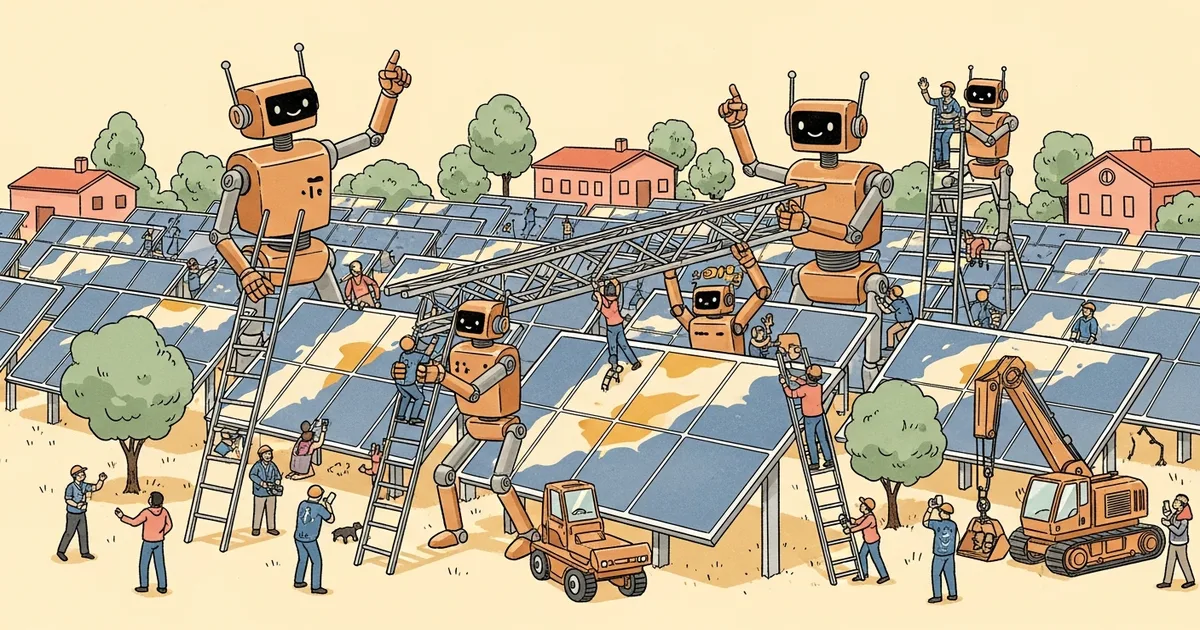
Maximo, the AI robotics company incubated within The AES Corporation and backed by NVIDIA’s Inception program, completed a 100-megawatt solar installation in April 2026 using an autonomous robot fleet — the first AI-powered system to build grid-scale solar infrastructure at commercial capacity. One hundred megawatts supplies roughly 18,000 U.S. homes. Maximo’s robots completed what would have taken a conventional crew significantly longer, without overtime costs, heat-related shutdowns, or unfilled job postings.
The timing is not coincidental. Solar construction labor shortages have become one of the primary bottlenecks to U.S. clean energy targets — and the same AI systems driving unprecedented electricity demand are now building the infrastructure required to meet it.
What Maximo’s Robot Fleet Actually Does
Maximo deploys autonomous field robots designed specifically for utility-scale solar panel installation — the most labor-intensive phase of large solar projects. The robots handle panel placement, mounting, and alignment across open terrain, tasks that currently require hundreds of workers per project and account for a substantial share of total installation costs.
The system uses computer vision and real-time sensor fusion to navigate irregular terrain, avoid obstacles, and position panels with high precision. Unlike warehouse automation, which operates in controlled environments, Maximo’s fleet is built for field deployment: dust, uneven ground, variable lighting, and the unpredictable conditions of utility-scale construction sites.
AES — which operates generation capacity across more than a dozen countries — incubated Maximo to address a problem it was experiencing firsthand: it couldn’t hire enough workers to build solar fast enough to meet contracted capacity targets. The robot fleet is the engineering answer to a workforce equation that wasn’t adding up.
The 100-MW Milestone in Context
One hundred megawatts is not a small pilot. It represents a meaningful fraction of many U.S. states’ annual solar additions and sits within the range of projects that major independent power producers count as commercially significant. The U.S. installed approximately 50 gigawatts of new solar capacity in 2024, according to the Solar Energy Industries Association (SEIA) — meaning 100 MW is 0.2% of a full year’s national additions from a single robot deployment.
That number becomes more meaningful when you consider speed and repeatability. Human crews are subject to weather delays, labor availability, and fatigue. Robot fleets, in principle, are not. If Maximo can deploy multiple teams simultaneously across different project sites, the 100-MW benchmark is a floor, not a ceiling.
The NVIDIA Inception backing is strategically significant. NVIDIA’s interest in energy infrastructure is not purely philanthropic — AI data centers run on NVIDIA GPUs, and GPU-dense facilities are among the most power-hungry buildings ever constructed. A company that manufactures the demand for electricity has a rational interest in the companies building supply.
Solar’s Labor Crisis Is Not a Future Problem
The U.S. solar industry needs to scale to roughly 1 million workers by 2035 to meet federal clean energy targets, according to Department of Energy workforce projections. Current solar employment stands at approximately 255,000 — the industry must nearly quadruple its workforce in a decade while simultaneously accelerating deployment timelines.
Panel installation is the binding constraint. It’s physically demanding, often done in direct sun at temperatures well above ambient, and requires specialized training. Turnover in construction trades runs approximately 21% annually, according to Bureau of Labor Statistics data, and solar installation skews higher. Retention is poor because the work is cyclical and project-based.
This creates a structural problem: the U.S. has legally committed to clean energy targets that require building solar faster than it can hire humans to build it. Automation isn’t optional here — it’s arithmetic. The displacement concerns that accompany most AI labor discussions look different in a sector where the labor simply isn’t available at the required scale.
The Recursive Loop: AI Demands Power, AI Robots Build It
The recursive quality of this situation deserves direct attention. AI training runs consume extraordinary amounts of electricity — a single training run for a large frontier model is estimated to consume between 1 and 10 gigawatt-hours depending on scale and hardware efficiency, equivalent to hundreds of thousands of homes’ annual usage compressed into weeks. Inference at scale compounds this further as adoption grows.
Microsoft, Google, and Amazon are collectively committing hundreds of billions of dollars to data center construction through 2030, the majority GPU-dense AI infrastructure. That infrastructure needs power. That power needs to come from sources that don’t antagonize corporate sustainability commitments. Solar is the default answer — and solar construction is bottlenecked by labor.
Maximo is, structurally, an AI company solving an AI-caused problem. The robot fleet uses computer vision models that run on GPUs, deployed to build solar farms that will power data centers that run GPUs. Autonomous systems are increasingly filling operational gaps that human capacity cannot close at the required pace — and energy infrastructure is becoming the clearest example of that pattern at scale.
AES’s Strategic Position
The AES Corporation is not a startup. It’s a Fortune 500 utility with global generation and grid infrastructure operations spanning more than a dozen countries, and a multi-gigawatt renewable energy construction pipeline. Its decision to incubate Maximo internally — rather than acquire an external robotics company or wait for the market to develop a solution — reflects how seriously AES treats construction bottlenecks as a strategic risk to its own project commitments.
Maximo is also a commercial product, not just internal tooling. It’s available to third-party solar developers, meaning AES incubated a company that now competes for contracts on projects AES doesn’t own. That’s an unusual structural choice, and it suggests AES sees platform dominance in solar robotics as more valuable than preserving a proprietary advantage within its own development pipeline.
What Comes After 100 Megawatts
The 100-MW deployment establishes commercial viability. The next question is fleet scale. A single robot team completing a 100-MW project is a milestone; fifty teams working simultaneously across the U.S. Southwest is a market transformation. Maximo hasn’t disclosed fleet size publicly, but the economics of autonomous construction favor aggressive expansion — robots don’t require relocation stipends, housing allowances, or benefits.
MegaOne AI tracks 139+ AI tools across 17 categories, and physical-world AI deployment — robotics, autonomous construction, field intelligence — is one of the fastest-growing segments in 2026. The pattern emerging from companies like Maximo is consistent: AI systems are moving from software into the physical infrastructure layer, and energy is the first major domain where the economics clearly justify the transition.
The 100-megawatt solar farm Maximo completed will generate power for decades. The robot fleet that built it will have moved on to the next site before the first kilowatt-hour reaches the grid. That’s the business model — and increasingly, the energy buildout’s only viable path forward.