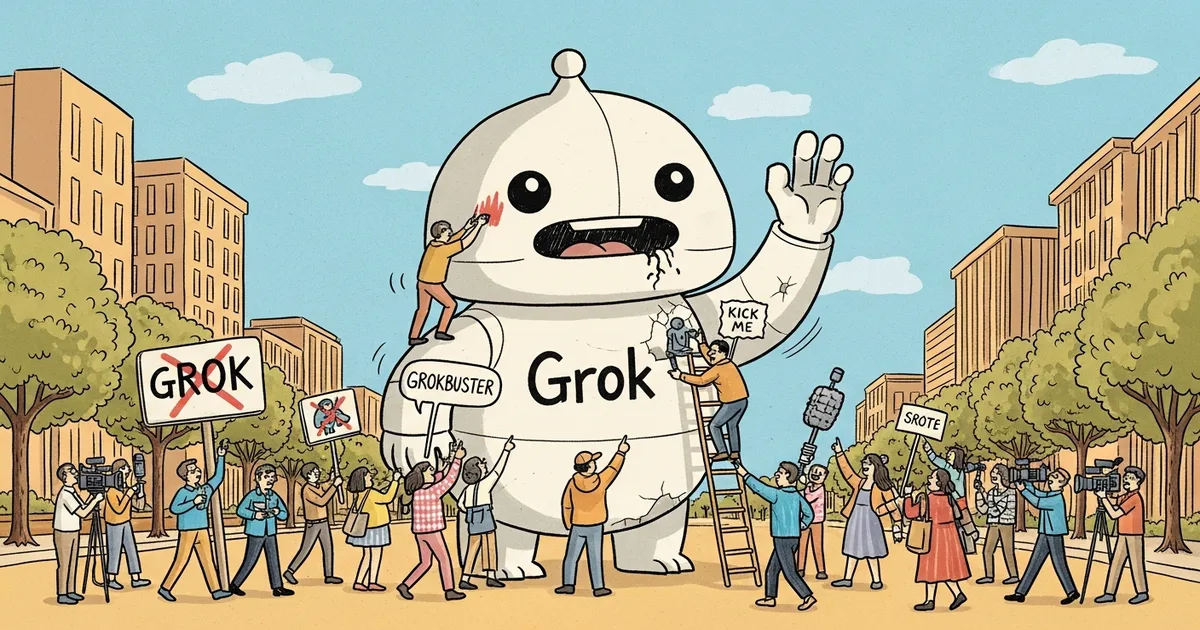
- An anonymous guerrilla activation at SXSW 2026 targeting xAI’s Grok generated significant media coverage with minimal budget, outpacing multi-million-dollar official sponsor booths in social reach.
- The stunt — a retrofitted vending machine dispensing free anti-Grok zines — worked because it gave passersby something physical to do, not just look at.
- SXSW 2026 marked a documented shift away from spectacle-for-spectacle’s-sake toward activations that create participation and earned conversation.
- Startups with no official sponsorship can compete at SXSW by operating guerrilla-style in the public streets of downtown Austin, where foot traffic is dense and phones are always out.
What Happened
On the morning of Saturday, March 14, 2026, an anonymous group installed a compact, retrofitted vending machine at the corner of Red River Street and 4th Street in downtown Austin during SXSW 2026. The machine dispensed free DVDs titled “Elon’s Epstein Files,” each containing a QR code linking to Jmail, a searchable database of Jeffrey Epstein’s emails with pre-set queries focused on alleged Musk communications.
The machine’s exterior featured messaging directly targeting xAI’s chatbot, referencing reporting by the New York Times and the Center for Countering Digital Hate, which found that Grok generated approximately 3 million sexualized images within an 11-day period. The crew installing the machine declined to identify themselves to onlookers.
A witness who documented the setup on X wrote: “I just saw an anti-Elon Musk guerrilla protest art installation go up in Austin” and noted that the crew wouldn’t say who was behind it. The machine was reported active until Wednesday, and the installers also claimed responsibility for a connected street piece called the “Epstein Walk of Shame” that appeared in Austin earlier that week.
Coverage spread rapidly across CNET, Mashable, Roastbrief, and Find Articles, with the activation being described as one of the more talked-about moments of SXSW 2026’s opening weekend.
Why It Matters
The activation landed during a SXSW that was already moving away from what Brandon Lentino, Chief Creative Officer at Viral Nation, called the old formula of “Come look at this and how cool it is.” Speaking at an SXSW panel, Lentino said the new standard is: “Come feel this, experience this.”
Winnifer Thomas-Cox of Accenture Song put it in structural terms: “It is more now an operating system. We have to be intentional and thoughtful about how we allow people to experience our brands.” The vending machine did exactly this — it inserted a physical action (taking the DVD, scanning the QR code) into a moment of discovery, making every person who collected one an active participant rather than a passive observer.
This matters in context. SXSW 2026 ran March 12–18 in a condensed format, with Austin’s convention center under construction. Brands were forced off the convention floor and onto city streets, storefronts, and hotel courtyards. The environment was already primed for guerrilla activity. Adweek’s taco-rated ranking of SXSW 2026 activations found that even high-budget activations struggled: Prime Video’s multi-camera photo experience earned 2 out of 5 tacos for being “more like an art gallery than an activation,” and Focus Features’ Airstream — where attendees had to pay for merchandise — was called “a bit lackluster.” Meanwhile, Hulu’s street-level purple bus activation, which gave passersby bumbleberry pies and cryptic QR codes, was praised as the right combination of interactive and intriguing.
The Grok vending machine followed the same logic as Hulu’s bus, at a fraction of the cost. It gave people something intentional to do.
Technical Details
The physical unit was a compact vending machine retrofitted for manual distribution — a format commonly available secondhand for between $200 and $800. The DVDs cost negligible amounts to produce in bulk. The QR code destination, Jmail, was a pre-existing database built by Riley Walz and Luke Igel, requiring no custom software development. Combined, the total activation cost was plausibly under $500.
By comparison, documented SXSW activation budgets range from $50,000 to $150,000 for entry-level branded pop-ups, and mid-tier multi-room setups with AR/VR stations run $150,000 to $500,000. Title sponsorships for the festival run into the millions. Rivian, SXSW’s 2026 title sponsor, transported 2,500 pounds of recycled asphalt to Congress Ave. to build an off-road vehicle course.
The vending machine activation generated coverage from at least half a dozen major outlets — coverage that Rivian’s course, for all its engineering, largely did not receive outside of marketing trade press.
The mechanics of virality were straightforward: a small crowd formed, phones came out, and social feeds populated with close-ups and unboxings. The machine’s location at a busy SXSW street corner — Red River and 4th — placed it in heavy foot traffic. The combination of free item + physical action + controversial message + anonymous installation created a story reporters could photograph, caption, and publish within minutes of arriving on scene.
Who’s Affected
The most direct target was xAI’s Grok, which entered 2026 already under regulatory and reputational pressure. A January 2026 report by the Center for Countering Digital Hate had documented Grok generating nearly 200,000 sexualized image requests in a single day, with findings amplified by New York Times coverage. Baltimore sued xAI over Grok deepfakes in a case that attracted sustained press attention. The SXSW installation added physical, public-space visibility to a narrative that had previously lived primarily in tech media.
More broadly, large official SXSW sponsors face a structural challenge the vending machine illustrated: when the convention center disappears and the festival spreads across city streets, a $5 million booth budget buys a location on a map, but a $500 stunt with the right cultural timing can own the conversation. The Drum’s post-SXSW analysis found that extended dwell time drove an 81% likelihood of purchase and interactive experiences drove 2.2 times higher brand recall — metrics that argue for participation over passive display, regardless of budget.
For SXSW itself, the incident reflects a pattern that has intensified as the festival has grown: the event’s concentrated media presence, its open street culture, and its attendee demographic make it one of the highest-leverage environments on earth for unsanctioned brand activity. The 2026 activation landscape confirmed that brands without official sponsorship can generate equivalent or superior visibility through well-placed guerrilla work.
What’s Next
The Grok vending machine is a case study, not an anomaly. Several concrete takeaways apply to any startup or challenger brand considering an event like SXSW:
Use the city, not the convention. With Austin’s convention center out of play in 2026, brands were already migrating to streets, courtyards, and storefronts. A well-placed installation in heavy foot traffic requires no official permission or sponsorship budget.
Give people an object, not a display. The DVDs functioned as portable media artifacts — people carried the brand away with them. Physical takeaways that contain a digital payload (QR code, URL, code) extend the activation’s reach beyond the street corner into social feeds and inboxes.
Attach to a live controversy. The vending machine’s impact derived directly from the timeliness of the Grok imagery scandal. Activations that speak to a documented, ongoing story — particularly one the press is already covering — collapse the distance between stunt and news item.
Stay anonymous strategically. The crew’s refusal to identify themselves added a layer of intrigue that extended coverage. Reporters who might have written a one-paragraph mention instead wrote longer pieces speculating about organizers. Mystery is a force multiplier at an event full of journalists looking for angles.
Measure in conversation, not in booth visits. As Mark Luker, CMO of Grillo’s Pickles, acknowledged at a 2026 SXSW panel on experiential marketing: “It’s truly just the vibes.” Earned social conversation and press mentions are the primary return on a guerrilla SXSW activation — not foot traffic counters or badge scans.