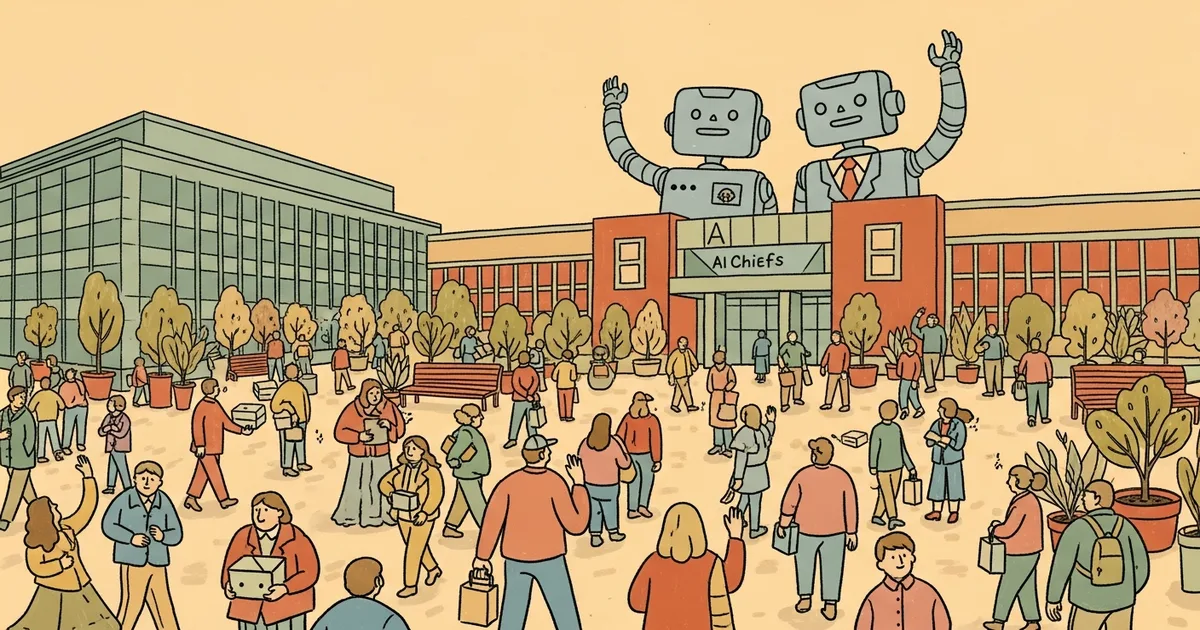
Atlassian — the enterprise software company behind Jira, Confluence, and Trello — confirmed in April 2026 that it is cutting approximately 1,600 employees, representing 10% of its global workforce, and redirecting $236 million in annual savings toward AI development and enterprise sales. At the same time, the company restructured its technology leadership, replacing its CTO with two new AI-focused co-CTOs. CEO Mike Cannon-Brookes framed the decision plainly: “AI has fundamentally changed the mix of skills the company needs.”
That is not a euphemism. It is a strategic reallocation with a nine-figure annual price tag — and the clearest signal yet that enterprise SaaS companies are moving from AI experimentation to AI-driven workforce restructuring.
The Math Behind the Atlassian Layoffs and 6 Million
Atlassian entered 2026 with approximately 16,000 employees. This 10% reduction is the largest single headcount cut in the company’s 22-year history, surpassing a 2023 round that affected roughly 500 roles. The $236 million figure represents projected annual savings — not a one-time restructuring charge — meaning Atlassian expects to operate structurally at lower labor costs in perpetuity.
For context, Atlassian generates more than $4 billion in annual revenue. A $236 million annual reduction in labor costs represents meaningful operating leverage for a company that has historically prioritized growth over margin expansion.
The cuts are concentrated in roles where AI tooling has materially reduced per-task labor requirements: software engineering support functions, quality assurance, certain product operations, and back-office functions. Atlassian has not published a granular breakdown by department, but the stated rationale — redirecting resources toward AI capabilities and enterprise go-to-market — implies the reductions skew toward execution-layer roles rather than strategic or customer-facing positions.
Two CTOs Instead of One: What That Structure Tells You
The replacement of a single CTO with two AI-focused co-CTOs is the most structurally significant decision in this announcement. It signals that Atlassian no longer views technology leadership as a unified discipline — the company now treats AI infrastructure and AI product as fundamentally distinct domains requiring dedicated executive ownership.
This dual-CTO model is still rare but gaining traction among large technology companies repositioning around AI. The logic is straightforward: a single CTO managing both foundational model integration and AI-driven product development faces an impossible scope of work. Splitting the role acknowledges that these are now separate domains with different talent requirements, different vendor relationships, and different success metrics.
The outgoing CTO’s departure — framed publicly as a mutual decision — arrives as Atlassian rebuilds its technical organization around AI-first assumptions rather than retrofitting AI capabilities onto a traditional software development org structure.
Which Roles Were Cut and Why the Pattern Matters
Atlassian’s official communications avoid a role-by-role accounting, but the pattern is readable from the company’s product direction. Atlassian has deployed AI agents across Jira, Confluence, and its Atlassian Intelligence platform to automate tasks that previously required dedicated headcount: ticket triage, documentation generation, sprint planning assistance, and customer support escalation routing.
Each of these use cases directly displaces labor from roles that enterprise software companies traditionally staff at scale. When an AI agent handles tier-1 support routing with high accuracy, the headcount model for that function changes permanently — not gradually.
The Humans First movement has argued that this displacement pattern is accelerating faster than workforce retraining programs can absorb. Atlassian’s announcement makes that tension concrete: 1,600 people did not lose their jobs because the company is struggling financially. They lost jobs because AI reduced the per-unit labor requirement for their functions.
The Enterprise Sales Bet: As Important as the Cuts
The second destination for the $236 million — enterprise sales infrastructure — receives less attention but carries equal strategic weight. Atlassian built its business on product-led growth: developers adopt Jira or Confluence organically at the team level, and usage expands upward through organizations. That motion is under pressure.
Enterprise AI procurement now happens at the C-suite level, with IT, security, legal, and finance all involved in approval cycles. Atlassian’s decision to invest in enterprise sales capacity signals that the company believes its next growth phase requires human account executives selling AI-augmented productivity suites to procurement committees — not waiting for organic bottom-up adoption to reach contract scale.
This is a fundamental strategic shift. Product-led growth optimizes for low acquisition cost and fast time-to-value. Enterprise sales optimizes for contract size, expansion revenue, and long-term retention. The two motions require different organizational structures, different incentive systems, and different talent profiles — which partly explains why headcount reduction and sales investment are announced together rather than sequentially.
The Broader SaaS Reckoning Atlassian Is Accelerating
Atlassian’s move is not isolated. MegaOne AI tracks 139+ AI tools across 17 categories, and the pattern across enterprise software is consistent: companies that built large workforces to execute on software delivery and customer support are discovering that AI agents can perform many of those same tasks at a fraction of the per-unit cost.
The calculus is structural, not cyclical. If an AI agent handles tier-1 support, automates QA regression cycles, or generates first-draft documentation at costs measured in API tokens rather than annual salaries with benefits, the economic pressure to reduce headcount does not reverse when the macro environment improves. The question for every SaaS company is not whether to run this calculation — it is when.
The rapid capability expansion of AI tools across content, video, and automation — documented in MegaOne AI’s 2026 comparison of ElevenLabs, HeyGen, and Synthesia — illustrates how quickly AI has shifted from supplementing human work to replacing discrete human task outputs entirely. The same dynamic has now hit software development support functions at enterprise scale.
Compute infrastructure is making AI deployment cheaper every quarter. Nebius’s planned $10 billion AI data center buildout in Finland is one indicator of the scale of infrastructure being deployed to support enterprise AI workloads — infrastructure that continuously reduces the marginal cost of running AI agents at production scale.
The Dual-CTO Model as an Emerging Industry Template
The traditional CTO role was designed for a world where technology strategy meant platform architecture, engineering hiring, and developer tooling. Those responsibilities have not disappeared — but they now sit alongside a second, equally complex set: AI model selection, agent deployment, data pipeline governance, AI ethics, and compliance frameworks.
Attempting to manage both domains in a single role sets CTOs up to fail by scope. Atlassian’s decision to split the function into two dedicated leadership positions is an honest acknowledgment of this reality. Whether the structure works in practice depends on how cleanly the two domains are scoped — AI product and AI infrastructure are natural divisions, but the boundary between them is actively contested in most organizations and requires clear executive authority to enforce.
The broader pattern of AI-driven organizational restructuring extends beyond org charts to acquisition strategy. AI acquisition activity has accelerated as large companies move to buy AI talent and intellectual property rather than building capability organically — a faster path to the “new mix of skills” Cannon-Brookes cited, for companies with the balance sheet to execute it.
What Every SaaS Leadership Team Is Now Deciding
Atlassian’s announcement removes one key piece of ambiguity from a debate that enterprise software companies have been having quietly: can you maintain a pre-AI headcount structure while building an AI-first product? At Atlassian’s scale and competitive position, the answer is no.
The $236 million in annual savings is not primarily a margin story. It is a reinvestment story. Companies that read this as cost-cutting are misreading the strategy. The accurate read: Atlassian cut roles whose outputs AI can now generate more cost-efficiently, and is redeploying that capital toward the AI capabilities that generate those outputs — and the sales infrastructure to monetize them at enterprise contract scale.
Every SaaS company with more than 2,000 employees is running a version of this calculation right now, whether openly or not. The companies that run it honestly and act on the results maintain the financial runway to make the AI transition deliberately. The companies that delay will face the same restructuring — without the capital position to do it on their own terms.
Atlassian just demonstrated what a deliberate transition looks like. It is not painless. It is a strategy.