- 94% of marketers report that personalization directly boosts sales, with beauty brands among the highest-performing adopters of AI-driven recommendation engines, according to HubSpot’s State of Marketing research cited by Shopify.
- Sephora’s AI recommendation system produced a 25% increase in average order value and a 17% rise in repeat customers, while MAC saw a 200% jump in online conversion rates after deploying virtual AI try-on technology.
- Unilever’s BeautyHub PRO AI platform drives a 39% higher basket value and makes consumers 43% more likely to complete a purchase versus browsing without it.
- Affordable tools like Klaviyo, Nosto, and Haut.AI now bring enterprise-grade personalization within reach of independent beauty brands, without six-figure technology budgets.
What Happened
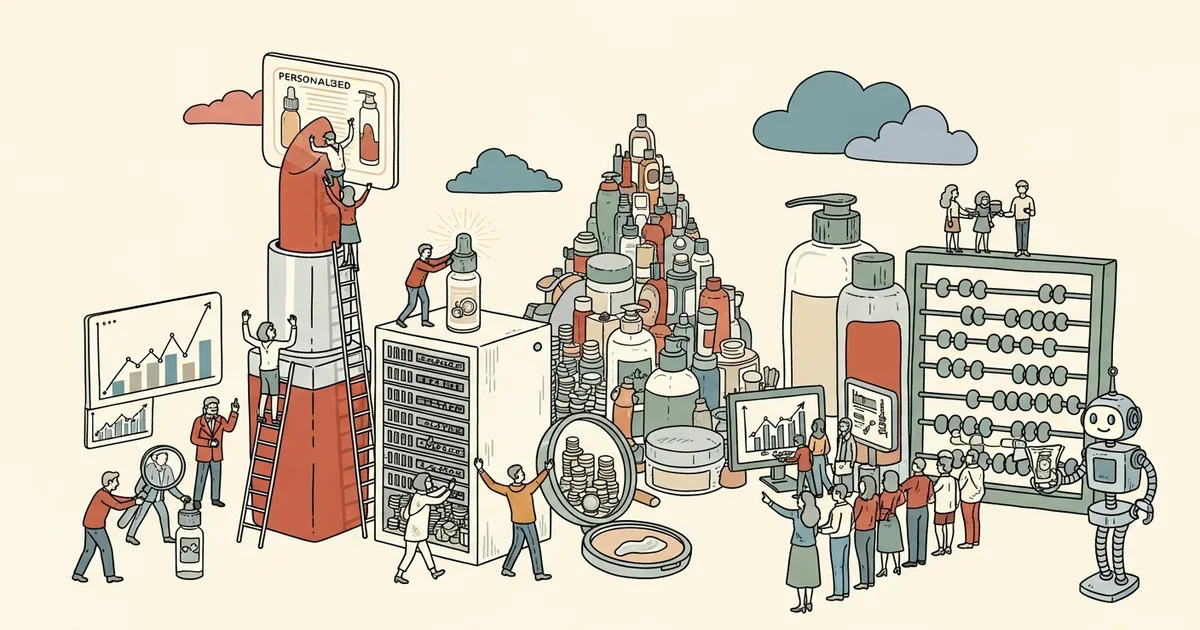
Personalization has moved from a marketing buzzword to a measurable revenue driver in beauty e-commerce. Research compiled by Shopify and sourced to HubSpot’s annual State of Marketing report finds that 94% of marketers say personalization boosts sales — a figure that lands with particular force in the beauty category, where product fit is highly individual and the cost of a wrong recommendation is a returned item and a lost customer.
The shift accelerated between 2024 and 2026 as generative AI, computer vision, and predictive analytics became commercially available at a price point accessible to brands well below enterprise scale. The result is a widening gap between beauty retailers deploying AI personalization and those still relying on static bestseller carousels.
NielsenIQ’s 2026 Global Beauty Market report found that the overall beauty market grew 10%, with online sales outpacing in-store by a factor of six. AI-influenced commerce was identified as a primary driver of that online acceleration.
Why It Matters
The economics of AI personalization in beauty are straightforward. Generic product pages convert poorly because shoppers cannot assess whether a foundation matches their skin tone or whether a serum is formulated for their specific concern. AI narrows that gap by surfacing the right product at the right moment, based on real behavioral and biometric data.
McKinsey’s analysis of beauty players scaling generative AI found that hyperpersonalized marketing messages can improve conversion rates by up to 40%, and that one unnamed global lifestyle player using a gen-AI shopping assistant saw conversion rates climb as much as 20% within the first deployment phase.
Fast-growing companies derive roughly 40% more revenue from personalization than slower-growing peers, according to Envive AI’s aggregated e-commerce lift statistics. Personalized recommendation engines alone account for up to 31% of retailer revenue when fully deployed.
For beauty specifically, the returns compound. A shopper who receives a correct foundation recommendation becomes a repeat customer. A repeat customer generates lifecycle value that dwarfs the initial acquisition cost. AI personalization is effectively a retention mechanism disguised as a sales tactic.
Technical Details
The technology stack powering these results operates across three layers.
Computer vision and virtual try-on. L’Oreal’s ModiFace platform, acquired in 2018, uses augmented reality and AI to allow shoppers to try on makeup in real time. L’Oreal reports that customers using the virtual try-on tool are 30% more likely to make a purchase. MAC deployed the same class of technology and saw a 200% increase in online conversion rates, according to case study data compiled by DigitalDefynd. Sephora’s Virtual Artist reduced product returns by 30% and increased conversion rates by 11%.
Behavioral recommendation engines. These systems analyze purchase history, browsing patterns, skin type inputs, and real-time session data to generate ranked product suggestions. Sephora’s implementation produced a 25% increase in average order value and made users 3.2 times more likely to complete a purchase after engaging with AI-powered recommendations. Unilever’s BeautyHub PRO, which uses computer vision to assess up to 30 visual data points from a selfie, drove a 39% uplift in basket value and a 43% improvement in purchase completion rates versus non-AI browsing sessions.
Automated marketing and predictive triggers. AI-driven email and SMS flows activate based on predicted customer intent rather than fixed schedules. Abandoned cart sequences using predictive personalization generate up to 47% of email revenue for some beauty brands, per Envive AI research. Companies using AI in marketing report 22% higher ROI, 47% better click-through rates, and campaigns that launch 75% faster than manually built campaigns, according to AllAboutAI’s 2026 marketing statistics compilation.
Who’s Affected
The brands executing this playbook most visibly are large players — Sephora, L’Oreal, MAC, and Unilever’s portfolio — but the competitive pressure falls on independent and mid-market beauty brands. Those brands cannot afford to lose ground on personalization when the major retailers have already demonstrated the conversion uplift it produces.
A 2025 consumer survey reported by CosmeticsDesign found that 76% of beauty shoppers are now open to using an AI-powered personal shopper, which signals that the consumer side of the adoption barrier has largely collapsed. Brands not offering personalized AI experiences risk appearing behind the curve to a majority of their potential customers.
The market for AI in beauty and cosmetics was valued at $4.9 billion in 2025 and is projected to reach $33.75 billion by 2035, growing at a 22.3% compound annual rate, according to InsightAce Analytic. That trajectory means the gap between AI-enabled and non-AI brands will widen considerably over the next decade.
What’s Next
The question for smaller beauty brands is not whether to adopt AI personalization but how to do it without an enterprise budget. The tools available in 2026 make a viable implementation possible at every revenue tier.
Start with email and SMS personalization. Klaviyo integrates directly with Shopify and WooCommerce, using purchase and browsing data to segment audiences and trigger personalized flows. It scales from early-stage DTC brands to multi-million-dollar operations and is consistently cited as the most accessible entry point for personalized marketing automation.
Add a recommendation engine to the storefront. Nosto and similar tools deploy recommendation widgets that replace static bestseller lists with individually ranked suggestions based on session behavior and purchase history. Both offer performance-based pricing tiers that make them viable for brands not yet at enterprise scale.
Deploy AI skin analysis for skincare brands. Haut.AI offers a plug-and-play SaaS skin analysis layer that converts a shopper’s selfie into a personalized routine recommendation. Its usage-based pricing model means brands pay for outcomes rather than seats.
Layer predictive analytics into inventory and campaign planning. Businesses using predictive analytics report up to 20% better forecasting accuracy and 20–30% reductions in inventory holdings, according to EComposer’s 2025 AI in e-commerce statistics. For beauty brands managing seasonal demand and short product lifecycles, that reduction in overstock directly improves margin.
The common thread across every high-performing implementation is data discipline. AI personalization produces better outputs when it draws on clean, unified customer data — purchase records, email engagement, on-site behavior, and skin profile inputs combined into a single customer view. Brands that invest in data infrastructure before layering AI on top consistently outperform those that deploy tools without a coherent data strategy underneath.