Key Takeaways
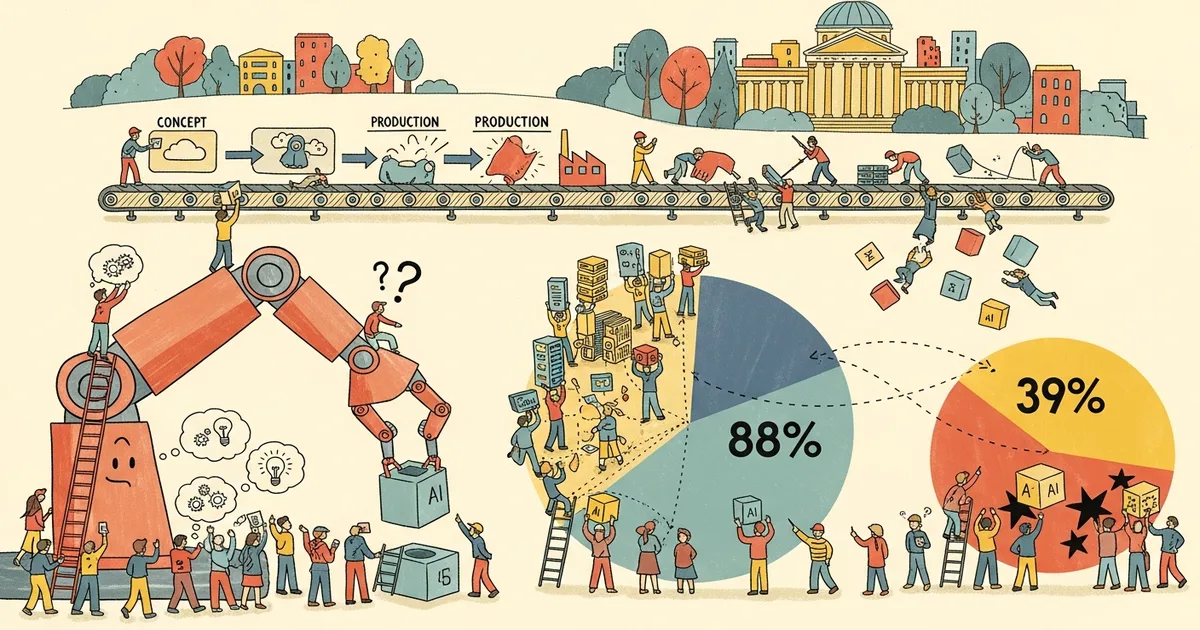
- McKinsey’s 2025 global survey found 88% of organizations now report regular AI use in at least one business function, but only 1% describe their rollout as “mature.”
- According to MIT Sloan Management Review research by Thomas Davenport and Randy Bean, 39% of companies have implemented AI in production at scale — up from 24% last year and less than 5% two years ago.
- Deloitte’s State of AI 2026 report confirms the gap: only 25% of organizations have moved 40% or more of their AI pilots into production, and just 34% are using AI to deeply transform their business.
- The AI skills gap is the top barrier, with talent readiness at only 20% across surveyed enterprises.
What Happened
Three major research reports published between late 2025 and early 2026 have converged on the same finding: enterprise AI adoption is nearly universal, but production-scale deployment remains the exception rather than the rule.
Thomas Davenport and Randy Bean’s annual AI and Data Leadership survey, published through MIT Sloan Management Review, found that 39% of companies have now implemented AI in production at scale. That represents significant progress — up from 24% the previous year and less than 5% two years ago — but it means 61% of enterprises are still stuck somewhere between experimentation and deployment.
McKinsey’s State of AI survey, which polled nearly 2,000 respondents across 105 countries, found that 88% of organizations now report regular AI use in at least one business function, up from 78% a year earlier. But only 1% describe their AI rollout as “mature,” and just 6% qualify as high performers seeing meaningful financial returns.
Deloitte’s State of AI in the Enterprise 2026 report, based on a survey of 3,235 senior leaders across 24 countries, titled its findings “From Ambition to Activation” — a polite way of saying most companies are still in the ambition phase.
Why It Matters
The 49-percentage-point gap between regular AI use (88%) and production-at-scale deployment (39%) is not just a statistic. It represents hundreds of billions of dollars in corporate spending that has not yet translated into measurable business outcomes.
Companies that do reach production scale are seeing substantial returns. Deloitte found that twice as many leaders as last year reported transformative impact from AI. Organizations that convert pilots to production are reporting ROI figures that justify their investment. But the majority of enterprises are spending on AI tools, training, and infrastructure without yet seeing commensurate returns.
This matters for every company allocating budget in 2026. The data suggests that buying AI tools is easy; making them work in production is the actual challenge — and the one most organizations have not solved.
Technical Details
The surveys identify specific bottlenecks preventing the jump from experimentation to production.
Data infrastructure remains the primary blocker. Davenport and Bean’s research found that AI has driven a renewed focus on data quality, with 70% of respondents now saying the chief data officer role is successful and established in their organizations — a more than 20% increase. This suggests companies are recognizing that AI models are only as good as the data they consume, but many are still building the plumbing.
Worker access has outpaced worker readiness. Deloitte found that employee access to AI tools rose 50% year-over-year, with 60% of workers now having access. But fewer than 60% of those with access regularly use the tools, and talent readiness sits at only 20%. The number one way companies are adjusting their talent strategies is through education, not hiring.
Surface-level implementation dominates. Deloitte categorized AI deployments into three tiers: 34% of organizations are using AI to deeply transform their business; 30% are redesigning key processes around AI; and 37% are using AI at a surface level with little or no change to existing workflows. The last group — more than a third of all enterprises — is essentially bolting AI onto existing processes without rethinking them.
Who’s Affected
The gap is not evenly distributed across industries or company sizes.
Large enterprises with dedicated data science teams and existing cloud infrastructure are far more likely to reach production scale. McKinsey’s high-performer category — the 6% seeing meaningful financial returns — skews heavily toward financial services, technology, and healthcare companies with more than $1 billion in annual revenue.
Mid-market companies face the steepest challenge. They have adopted AI tools at rates approaching those of large enterprises but lack the engineering teams to move from proof-of-concept to production. For these organizations, the gap between experimentation and deployment is widest.
CIOs and CTOs are under increasing pressure to show ROI on AI investments that boards approved in 2023 and 2024. The MIT Sloan data gives them a benchmark — 39% at production scale — but also sets a bar that the majority have not cleared.
Employees face a different kind of impact. With AI reshaping job functions across industries, workers in organizations that have not reached production deployment are simultaneously being told AI will transform their roles while not yet experiencing that transformation in practice.
What’s Next
Deloitte’s data offers one reason for optimism: more than half of organizations surveyed believe they will move 40% or more of their AI projects into production within six months. If that projection holds, 2026 could be the year the adoption-to-production gap begins to close meaningfully.
The rise of agentic AI — autonomous systems that can execute multi-step tasks without human oversight — is the next frontier. MIT Sloan Management Review’s research on the “emerging agentic enterprise” finds that leaders must navigate a fundamentally different operating model as AI agents move from tools that assist humans to systems that act independently.
For enterprises still in the experimentation phase, the research points to three priorities: invest in data infrastructure before scaling AI models; close the skills gap through education rather than hiring alone; and redesign workflows around AI rather than layering it on top of existing processes.
The 39% figure will be the number to watch. If MIT Sloan’s next annual survey shows that number crossing 50%, it will signal that enterprise AI has cleared its most difficult hurdle. If it stalls, the industry may be facing a longer road to production than the current hype cycle suggests.