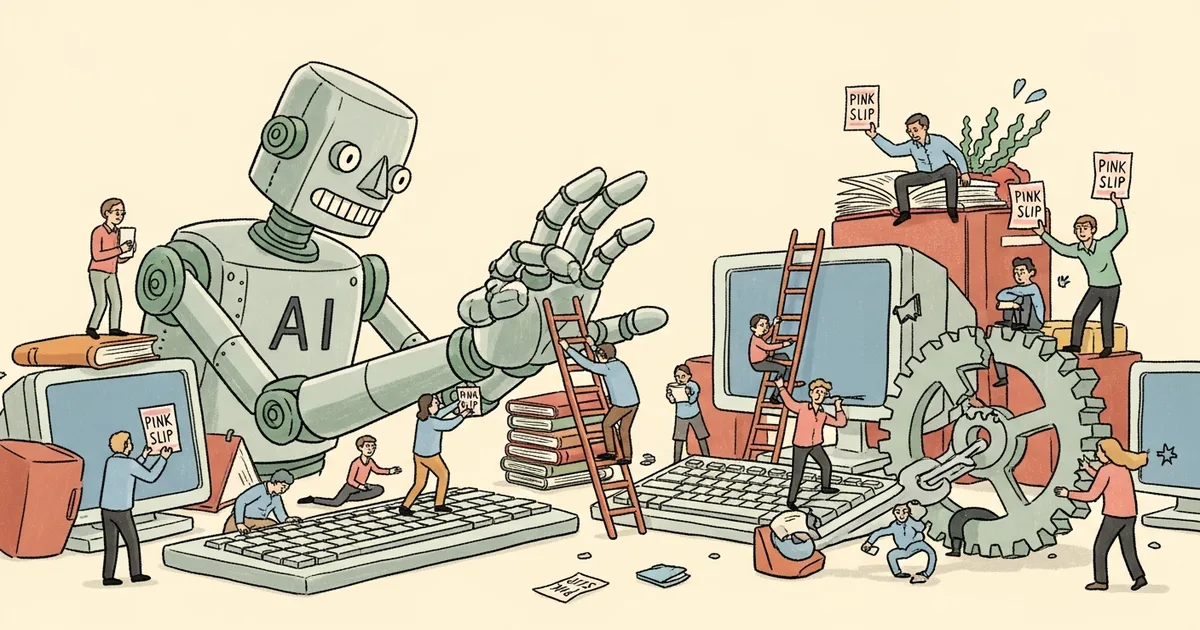
The New York Times Magazine published a critique arguing that Silicon Valley’s embrace of “agentic” AI serves as convenient rhetoric for tech CEOs who want to justify layoffs. The piece claims the term “agentic” has become a buzzword that obscures the gap between AI demo capabilities and production reality.
The NYT’s Argument
The critique makes three specific claims:
1. “Agentic” is vague enough to mean anything. When a CEO says their product is “agentic,” they might mean it can browse the web, execute multi-step tasks, use tools, or simply follow instructions with less hand-holding. The term lacks a technical definition, making it useful for marketing but meaningless for evaluation.
2. The demos don’t match production reality. Company demonstrations show AI agents completing complex workflows flawlessly. In production, the same agents fail on edge cases, require human intervention, and produce inconsistent results. The NYT cited several enterprise deployments where “agentic” AI required more human oversight than the manual processes it replaced.
3. “Agentic” framing justifies layoffs. When companies describe AI as autonomous agents that can handle tasks independently, it creates the narrative infrastructure for reducing headcount. The language matters: “automating a task” sounds incremental; “deploying an agent” sounds like hiring a replacement.
The Disconnect Between Demos and Production
The NYT piece cited specific examples:
- A customer service “agent” that handled 85% of inquiries in demos but only 40% in production, where real customer queries were messier and more ambiguous
- A code review “agent” that caught bugs reliably in controlled tests but generated false positives at 3x the rate in production codebases
- A data analysis “agent” that produced accurate reports on clean datasets but failed silently on real-world data with missing values and inconsistent formats
Is It Fair?
The critique has merit but overstates its case. Genuine technical progress has occurred — models like Arcee’s Trinity score 94.7% on agentic benchmarks, and multi-step tool calling has improved dramatically since 2024. The gap between demo and production is narrowing.
But the NYT is right that the word “agentic” has been co-opted. When 52,000 tech workers lost their jobs in Q1 2026 and every company cited AI, the linguistic connection between “autonomous agents” and “autonomous layoffs” is hard to ignore.
The Real Question
The useful distinction isn’t between “agentic” and “not agentic” — it’s between AI that genuinely reduces the need for human work and AI that creates different human work (supervision, error correction, training data curation). Much of what companies call “agentic” AI falls into the second category. The productivity gain is real but smaller than the marketing implies, and the headcount reduction often just shifts jobs from one department to another rather than eliminating them entirely.