What Happened
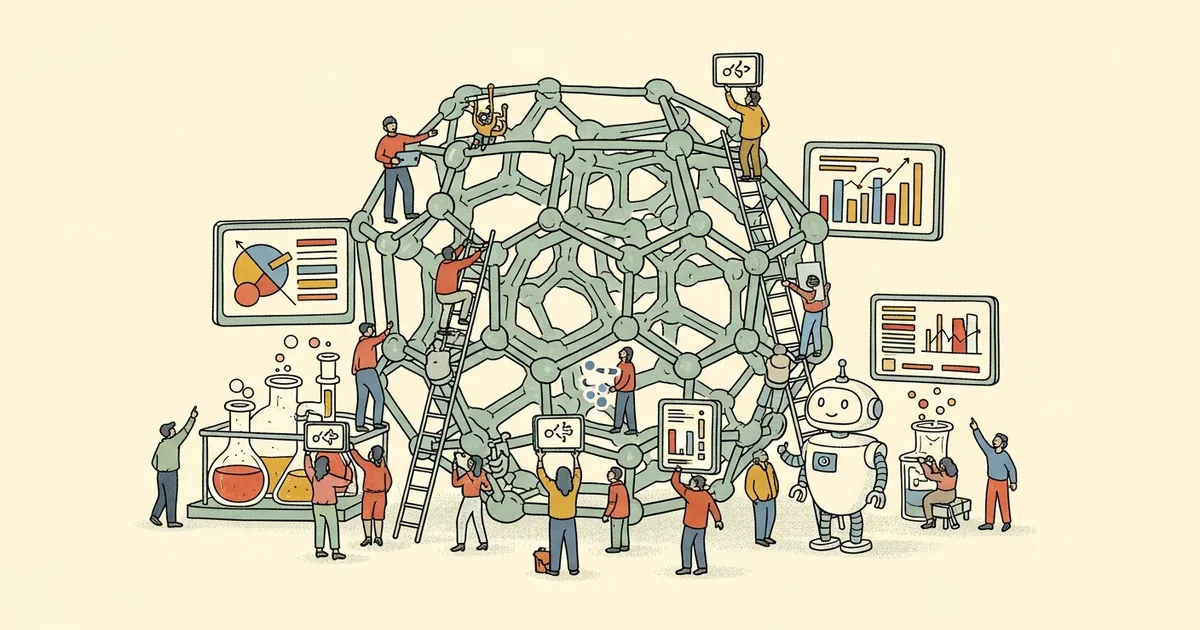
Researchers Jaewoong Lee, Taeun Bae, and Jihan Kim submitted a paper titled SimMOF: AI agent for Automated MOF Simulations to arXiv on March 31, 2026. The work introduces a large language model-based multi-agent framework that automates end-to-end metal-organic framework (MOF) simulation workflows from natural language inputs. The system targets four specific access barriers that have historically confined MOF simulation to domain experts.
- SimMOF is a large language model-based multi-agent framework for automating MOF simulation workflows end-to-end
- The system accepts plain natural language queries and translates them into structured, dependency-aware simulation plans
- Four barriers addressed: workflow construction, parameter selection, tool interoperability, and preparation of computationally ready structures
- Case studies demonstrate workflows described as adaptive and cognitively autonomous, intended to replicate the iterative decision-making of expert researchers
Why It Matters
Metal-organic frameworks are porous crystalline materials built from metal ions or clusters linked by organic ligands. They have attracted sustained research interest for applications including gas storage, carbon capture, catalysis, and drug delivery, owing to their high surface areas and tunable pore geometries. The theoretical design space spans millions of possible MOF structures, making computational pre-screening an essential step before laboratory synthesis.
Running reliable MOF simulations requires expertise that spans multiple disciplines. A researcher must correctly sequence a simulation workflow, select appropriate force fields and run parameters, manage the integration of software tools that were not designed to interoperate, and prepare raw crystal structure files into formats that simulation engines can process. This division of required skills limits the pace at which experimental and computational MOF research can interact.
The application of language models to lower the barrier to scientific simulation follows a pattern seen in other computational domains, where agentic systems have been applied to tasks such as code generation, laboratory automation, and literature synthesis. MOF research presents a well-defined testbed for this approach because simulation workflows are structured enough to be described procedurally, yet complex enough to require domain-specific reasoning at each decision point.
Technical Details
SimMOF places a large language model at the center of a multi-agent architecture. According to the paper’s abstract, “SimMOF translates user requests into dependency aware plans, generates runnable inputs, orchestrates multiple agents to execute simulations, and summarizes results with analysis aligned to the user query” — Lee, Bae, and Kim (2026). The phrase “dependency aware plans” refers to a scheduling approach in which the system identifies which simulation tasks must be completed before others can begin, rather than executing steps in a fixed sequence.
The four technical barriers the system targets are workflow construction (sequencing simulation steps in the correct order), parameter selection (choosing force fields, temperature, pressure, and cutoff radii), tool interoperability (bridging software environments that do not natively communicate), and computational structure preparation (generating clean, charge-assigned structures that simulation engines can process).
The authors describe adaptive and cognitively autonomous workflows through representative case studies in which SimMOF’s behavior is claimed to reflect “the iterative and decision driven behavior of human researchers.” The publicly available abstract does not include quantitative benchmarks, success rates, or comparisons against baseline methods. Full experimental validation details would be available in the paper body.
Who’s Affected
Computational materials scientists and chemists working on MOF screening workflows are the primary users the system is designed to serve. Researchers without deep computational expertise — such as synthetic chemists who understand MOF chemistry but not simulation software stacks — may gain access to workflows that previously required specialist support or cross-disciplinary collaboration. The paper does not identify specific institutional or commercial partners, and the system’s availability for external use was not stated in the abstract.
Groups running large-scale MOF screening campaigns targeting carbon capture or hydrogen storage candidates could benefit from a framework that executes simulation workflows from natural language descriptions without manual pipeline assembly.
What’s Next
The authors describe SimMOF as “a scalable foundation for data-driven MOF research,” indicating intent to position the framework as infrastructure for broader research efforts rather than a single-use tool. Independent replication, broader benchmarking across diverse MOF families, and direct comparison against manual expert workflows would be necessary validation steps before the system could be adopted in production research pipelines.
Direct quotes from the authors beyond the abstract text were not available at time of publication. Institutional affiliations for the research team were not listed in the arXiv submission.