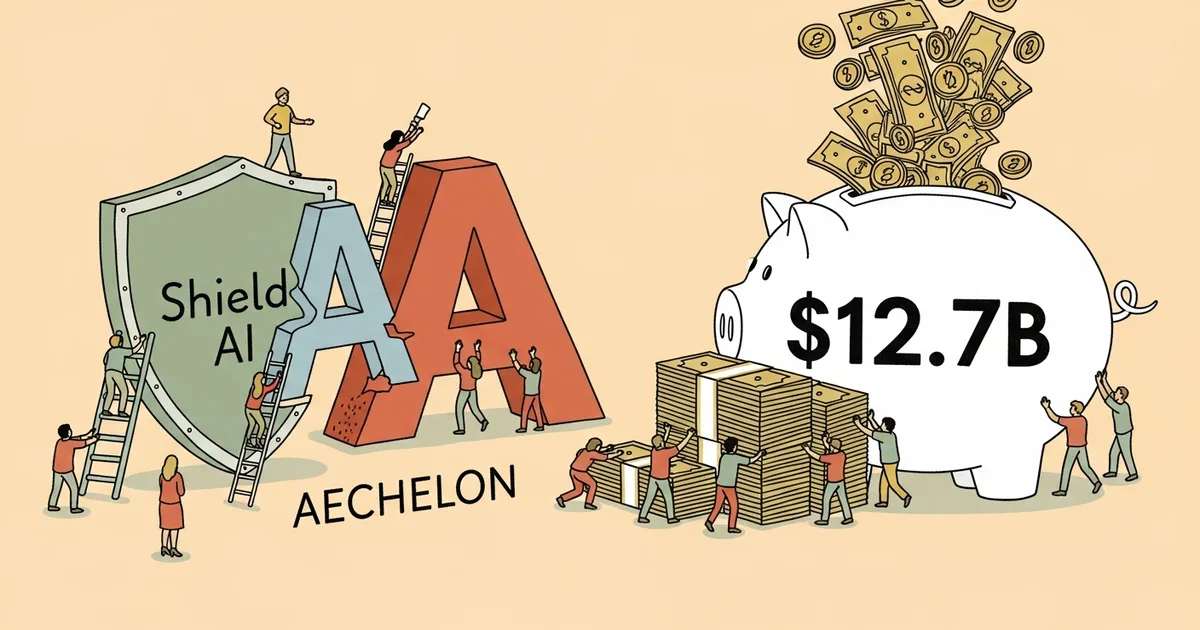
- Shield AI announced it will acquire Aechelon Technology, a software simulation company that builds high-fidelity visual environments for military flight training systems.
- The company is raising $2 billion in new capital at a post-money valuation of $12.7 billion, more than doubling its reported ~$5.3 billion valuation from its 2024 Series F round.
- The acquisition is intended to integrate Aechelon’s simulation software directly with Shield AI’s Hivemind autonomous pilot platform, expanding the testbed available for training and validating AI-piloted aircraft.
- Shield AI, founded in 2015, has now become one of the highest-valued private defense-AI companies in the United States.
What Happened
Shield AI announced it will acquire Aechelon Technology, a software simulation firm specializing in high-fidelity visual database environments for defense flight simulators, and simultaneously raise $2 billion in new capital at a $12.7 billion valuation, according to a press release published by Shield AI. The announcement marks the latest financing milestone for the San Diego-based autonomous aviation company, which has built its business around the Hivemind AI pilot platform.
Why It Matters
The deal reflects the continued consolidation of the defense AI supply chain, as prime autonomous systems developers move to acquire the simulation infrastructure needed to train and certify AI pilots at scale. Shield AI’s prior disclosed valuation stood at approximately $5.3 billion following a 2024 Series F round; the $12.7 billion figure represents a roughly 2.4x step-up in under two years, consistent with the accelerating capital flows into defense-technology companies following renewed government focus on autonomous systems procurement.
The acquisition of Aechelon specifically targets a bottleneck in autonomous aviation development: the availability of high-fidelity synthetic training environments. Simulation throughput — not just algorithmic capability — has increasingly been identified by defense researchers as a limiting factor in validating AI pilot behavior across diverse operational scenarios.
Technical Details
Aechelon Technology produces visual database (VDB) software that generates photorealistic 3D terrain and environmental data for military flight simulators, including systems deployed by defense contractors such as CAE and L3Harris. Its simulation environments are used to replicate real-world sensor conditions — including infrared, electro-optical, and radar returns — for training human pilots and, increasingly, for validating autonomous systems.
Shield AI’s Hivemind platform is designed to enable autonomous flight for fixed-wing aircraft and unmanned systems without reliance on GPS or communications links. The platform has been demonstrated on platforms including the F-16 and MQ-9 Reaper. Integrating Aechelon’s VDB technology would allow Shield AI to run Hivemind through a broader and more controllable range of synthetic mission scenarios before live-flight testing — a capability directly relevant to U.S. Air Force and Navy certification requirements for autonomous combat aircraft.
The $2 billion raise, combined with the Aechelon acquisition, suggests Shield AI is positioning for large-scale Department of Defense contract competitions, where validated simulation records are increasingly part of the technical proposal requirements.
Who’s Affected
The deal directly affects defense contractors and government agencies that operate autonomous aviation programs. Competitors building AI pilot capabilities — including companies such as Joby Aviation’s defense arm, Sarcos, and DARPA-backed autonomous systems programs — now face a rival with a vertically integrated simulation stack. Prime contractors that have used Aechelon’s VDB software as a standalone product may find the company’s roadmap more tightly coupled to Shield AI’s platform priorities going forward.
Shield AI co-founder and CEO Brandon Tseng has previously described Hivemind as the company’s core product, intended to be embedded across a wide range of military aircraft. The expanded capital base and simulation capability would support that strategy at greater scale.
What’s Next
The acquisition is subject to standard regulatory and closing conditions. Shield AI has not disclosed the specific investors in the $2 billion round or the financial terms of the Aechelon deal. Once closed, the combined entity will control both the autonomous pilot AI and a significant portion of the simulation infrastructure used to validate it — a vertical integration that has few direct precedents in the defense-AI sector.