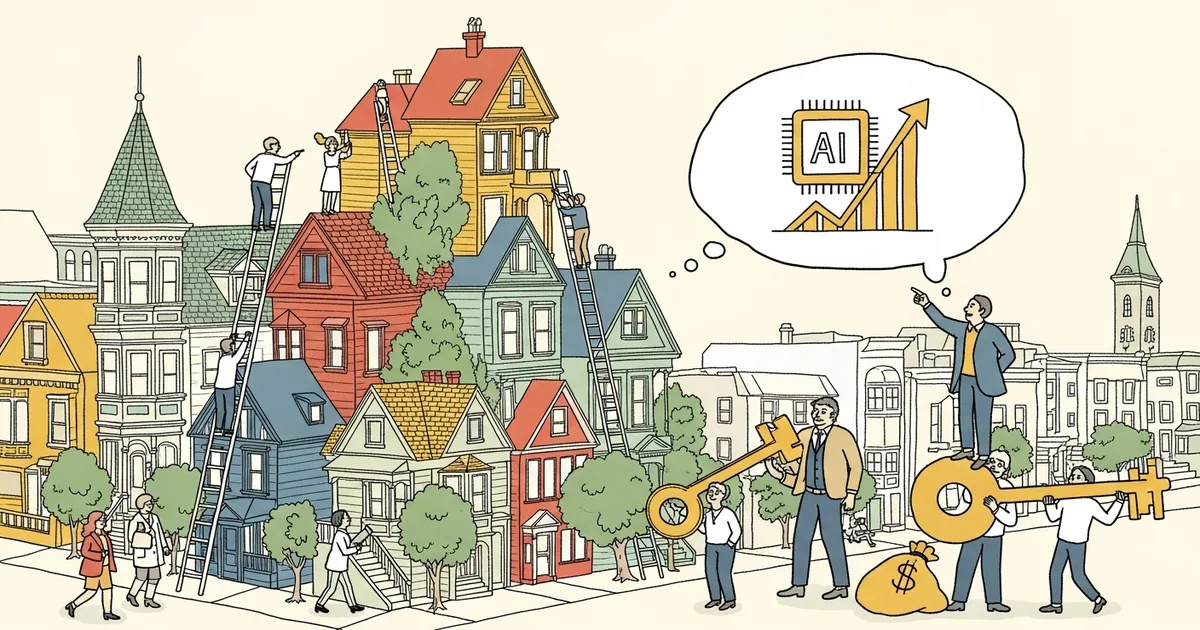
- San Francisco’s median residential sale price reached $2.15 million in March 2026, a record high according to brokerage Compass Inc.
- The figure represents an 18% increase from March 2025, which Compass attributed to wealth generated by AI startups concentrated in the city.
- At an 18% annual growth rate, the implied March 2025 median was approximately $1.82 million — itself an elevated baseline from prior tech cycles.
- The appreciation compounds pressure on prospective buyers without AI-sector equity, including non-tech workers and early-career employees who have not yet received significant payouts.
What Happened
San Francisco’s median residential sale price climbed to $2.15 million in March 2026, an 18% year-over-year increase, according to data from brokerage Compass Inc. cited in a Bloomberg report published April 6, 2026. Compass identified wealth generated by AI startups as the primary driver. The $2.15 million figure marks the highest recorded median for the city’s residential market.
Why It Matters
San Francisco’s housing market has historically tracked the fortunes of the technology sector. The mid-2010s boom driven by pre-IPO wealth at companies including Uber, Airbnb, and Lyft produced sharp price appreciation that partially reversed during the 2022–2023 Federal Reserve rate hike cycle, when rising mortgage costs cooled demand across the Bay Area. The 18% year-over-year gain in March 2026 surpasses those prior peaks in nominal terms and indicates that AI-sector compensation — structured around large equity grants at high-valuation startups — is now translating into residential purchasing power at a pace that exceeds the previous cycle.
Technical Details
The $2.15 million median represents closed residential transactions tracked by Compass Inc. across San Francisco in March 2026. At an 18% year-over-year growth rate, the implied March 2025 median was approximately $1.82 million, itself above historical norms. Compass’s data covers both single-family homes and condominiums within its brokerage transaction set. The brokerage attributed the acceleration specifically to AI startup wealth, a category that encompasses pre-IPO equity, secondary share sales at late-stage firms, and elevated cash compensation packages — forms of liquidity that have increased in frequency as AI companies have moved toward public markets in late 2025 and early 2026.
Who’s Affected
Current San Francisco homeowners have seen significant paper appreciation, while prospective buyers without meaningful AI-sector equity exposure face a median entry price that places ownership out of reach for the majority of city residents. Non-tech workers, renters, and employees at earlier career stages — including those at AI companies who have not yet received significant vesting or liquidity — face indirect pressure as high-income buyers absorb available inventory across multiple neighborhood types. Employers outside the AI sector that recruit for San Francisco-based roles must compete against a cost-of-living environment anchored to AI compensation benchmarks.
What’s Next
Whether the March 2026 price level represents a durable plateau or a continuing upward move will depend partly on the pace of AI startup liquidity events — IPOs and secondary transactions — that have accelerated in early 2026. Compass Inc. did not publish a forward price forecast in the Bloomberg report. Closing data from April and Q2 2026 will indicate whether the 18% annual appreciation rate is sustained or begins to moderate as interest rate conditions and equity market volatility factor into buyer decisions.