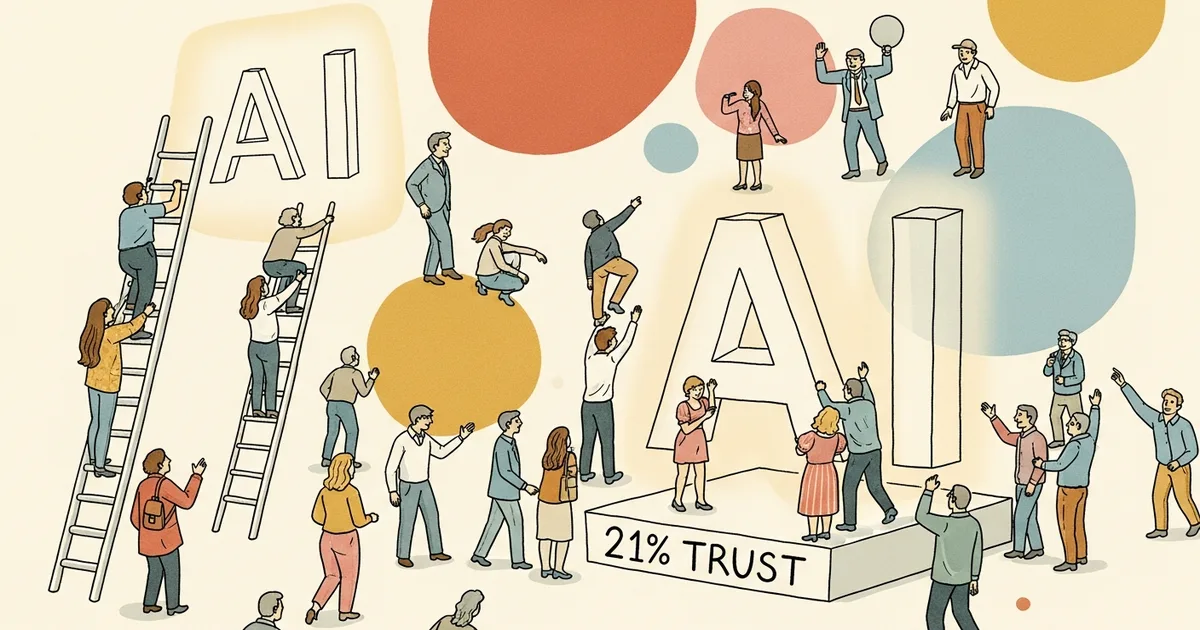
- 51% of US adults now use AI for research, up from 37% in April 2025, while only 21% trust AI-generated results—a figure unchanged year-over-year.
- 55% of respondents say AI does more harm than good in daily life, up 11 percentage points from April 2025.
- Gen Z is the most pessimistic generation about AI’s effect on employment (81%), yet is the least likely to use AI professionally (21% of employed Gen Z members).
- 80% of respondents said they would refuse a job where an AI program acts as their direct supervisor.
What Happened
Quinnipiac University released a national survey on AI attitudes in early April 2026, polling 1,397 randomly selected US adults by phone—800 of them employed—with a margin of error of ±3.3 percentage points. The poll finds that AI tool usage has expanded significantly over the past year, but measures of public trust, optimism, and confidence in AI governance have not kept pace, and in several cases have declined.
Why It Matters
The results run counter to what many AI developers and industry observers had anticipated: that growing familiarity with AI tools would translate into greater public confidence. A comparable Quinnipiac survey from April 2025 showed 44% of Americans believed AI did more harm than good in daily life; that figure now stands at 55%. Concern about AI also cuts across every generation—78% of Gen Z, 81% of Millennials, 79% of Gen X, and 82% of Baby Boomers reported being concerned.
The poll arrives as Congress and federal agencies face mounting pressure to establish clearer rules for AI development and deployment. Seventy-four percent of respondents now say the government is not doing enough to regulate AI, up from 69% a year ago, while 76% say companies are insufficiently transparent about how they use the technology.
Technical Details
The survey recorded a 14-percentage-point jump in AI use for research (from 37% to 51%), along with gains in data analysis (17% to 27%), image generation (16% to 24%), and school or work projects (24% to 27%). Twenty percent said they use AI for medical advice. The share who have never used AI fell from 33% to 27%.
Despite that expanded usage, trust in AI outputs remained static. Only 21% said they trust AI-generated information “most of the time” or “almost always”; 76% said they trust it only “sometimes” or “hardly ever.” “The contradiction between use and trust of AI is striking,” said Chetan Jaiswal, associate professor of computer science at Quinnipiac University. “Americans are clearly adopting AI, but they are doing so with deep hesitation, not deep trust.”
On workplace AI specifically, the survey found a sharp education and occupation divide: 50% of college-educated workers use AI professionally, compared to 22% of those without a degree. White-collar workers use AI at work at a rate of 49%, versus 18% for blue-collar workers. Overall, 32% of employed adults said they use AI on the job.
Who’s Affected
Gen Z presents the starkest internal contradiction in the data. Tamilla Triantoro, associate professor of business analytics at Quinnipiac University, noted that “younger Americans report the highest familiarity with AI tools, but they are also the least optimistic about the labor market. AI fluency and optimism here are moving in opposite directions.” Eighty-one percent of Gen Z respondents—those born between 1997 and 2008—expect AI to reduce job opportunities, the highest share of any generation, yet only 21% of employed Gen Z members use AI at work, the lowest share of any generation surveyed.
Healthcare and education sectors face particularly strong skepticism. Sixty-four percent of respondents said AI does more harm than good in education, up from 54% in April 2025. In healthcare, 81% said they would prefer a combination of AI and a human doctor when evaluating medical scans—even if AI has been demonstrated to be more accurate in that task. “This desire for a ‘second opinion’ from a human being, even if proven they aren’t as accurate as AI, reflects the lack of trust in AI that we see throughout the poll,” said Brian O’Neill, associate professor of computer science at Quinnipiac University.
AI infrastructure companies face broad public resistance as well: 65% of respondents oppose AI data centers in their local communities, citing electricity costs (72% of opponents), water consumption (64%), and noise (41%). Eighty percent of respondents said they would not accept a job where an AI program serves as their direct supervisor—assigning tasks and setting schedules—including 82% of Gen Z respondents.
What’s Next
Only 5% of respondents believe AI development is being driven by organizations that represent their interests—a figure that underscores a structural confidence gap that usage growth alone has not closed. Jaiswal summarized the poll’s central finding plainly: “Americans are not rejecting AI outright, but they are sending a warning. Too much uncertainty, too little trust, too little regulation, and too much fear about jobs.”
With 38% of respondents favoring a complete ban on AI-generated content in political advertising and 45% demanding mandatory disclosure, and with 28% of all adults—and 38% of Gen Z—reporting they have unknowingly shared an AI-generated video, pressure on both platforms and regulators to act on AI content labeling is likely to grow through the remainder of 2026.