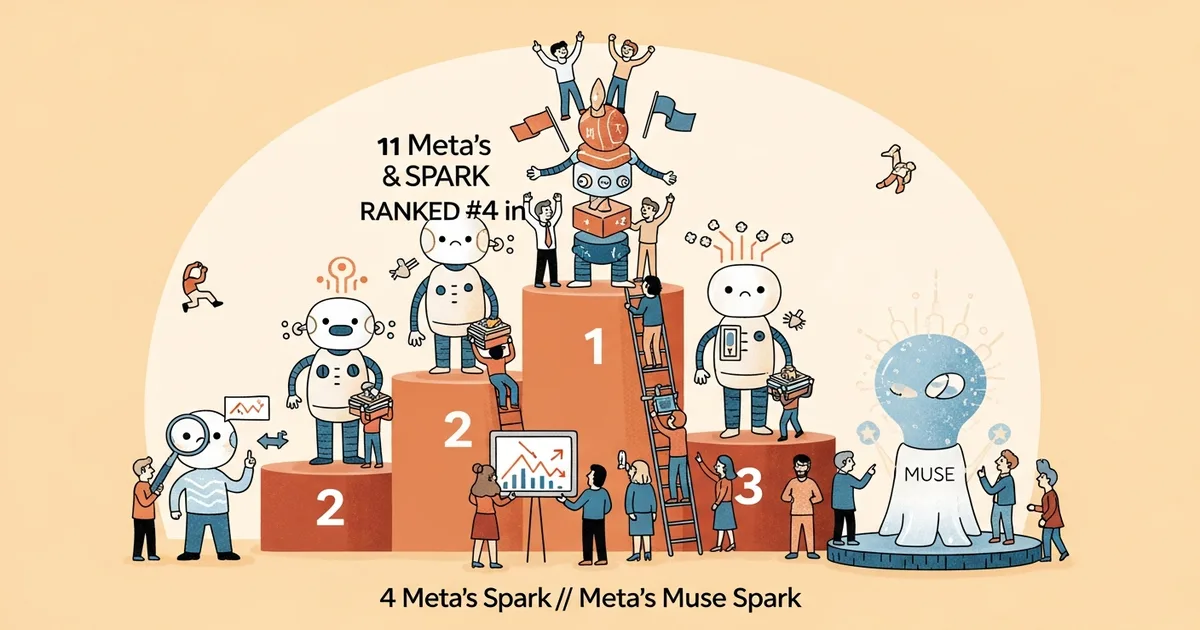
Meta’s Muse Spark — the company’s latest flagship model, positioned on release as its “most powerful model ever” — scored 52 on the Artificial Analysis Intelligence Index v4.0 as of April 10, 2026, placing fourth behind Gemini 3.1 Pro Preview (57), GPT-5.4 (57), and Claude Opus 4.6 (53). The gap between Meta’s launch messaging and the composite benchmark result is exactly 5 points — measurable, consistent, and hard to spin away.
Muse Spark is a real model with real strengths. It also finished fourth. Both things are true, and the benchmark breakdown explains why each matters.
Muse Spark Benchmark Rankings vs. Frontier Models
The Artificial Analysis Intelligence Index v4.0 aggregates performance across reasoning, coding, mathematics, and multimodal tasks into a single composite score. Muse Spark’s 52 places it in a distinct tier below the co-leaders.
| Model | Intelligence Index Score | Rank |
|---|---|---|
| Gemini 3.1 Pro Preview | 57 | #1 (tied) |
| GPT-5.4 | 57 | #1 (tied) |
| Claude Opus 4.6 | 53 | #3 |
| Muse Spark | 52 | #4 |
A 5-point gap on a composite intelligence index is not noise. The Artificial Analysis methodology aggregates dozens of sub-tasks — a consistent underperformance across that breadth is a signal, not an outlier.
Where Muse Spark Wins: CharXiv Reasoning Is Genuinely Best-in-Class
Muse Spark’s 86.4% score on CharXiv Reasoning is its headline result — and it earns that headline. CharXiv tests the ability to interpret and reason over scientific figures, charts, and data visualizations embedded in academic papers. It’s one of the harder multimodal benchmarks precisely because it requires integrating visual structure with domain-specific reasoning, not just optical character recognition.
MegaOne AI tracks 139+ AI tools across 17 categories, and figure-level multimodal reasoning remains one of the most practically underserved capabilities in the market. An 86.4% result — best among the top four models — is a concrete advantage for research synthesis, financial document analysis, and any enterprise workflow built around visual data interpretation.
HealthBench Hard came in at 42.8% — competitive in a medical reasoning domain where frontier models routinely score below 50%. Clinical decision-support is an area where even incremental improvements carry significant real-world weight. The number is worth watching as medical AI procurement accelerates through 2026.
Where Muse Spark Loses: ARC-AGI 2 Undermines the ‘Most Powerful’ Claim
The most consequential result for Meta’s positioning is 42.5 on ARC-AGI 2 — the abstract reasoning benchmark designed by François Chollet specifically to resist training data memorization. ARC-AGI 2 presents novel visual puzzles that require genuine compositional reasoning, not pattern recall. Human performance averages roughly 85%; most frontier models still fall below 50%.
Muse Spark’s 42.5 is not a collapse — it’s squarely in the range for current frontier models. But it’s the benchmark that most directly interrogates the “most powerful” claim. Abstract reasoning is where the gap between a well-trained specialist and a general-purpose reasoner becomes visible, and it’s where Gemini 3.1 Pro Preview and GPT-5.4’s higher composite scores originate.
The split — world-class on CharXiv, mid-pack on ARC-AGI 2 — tells a consistent story about Muse Spark’s architecture.
The ‘Contemplating Mode’ Architecture: What It Does and Where It Falls Short
Muse Spark runs on a parallel sub-agent architecture with a feature Meta calls “Contemplating mode.” Multiple specialized sub-agents process different aspects of a query simultaneously before a synthesis layer produces the final output. The design is intended to reduce the cognitive load on any single model component and improve performance on complex, multi-step tasks.
The CharXiv result validates the architecture for structured decomposition problems. Scientific figure reasoning can be cleanly parallelized — one sub-agent handles visual structure, another handles domain terminology, a third handles numerical relationships. Parallel processing across these tracks produces measurably better results than a monolithic approach.
ARC-AGI 2 tells the opposite story. Novel abstract problems are specifically designed to resist decomposition — the puzzle structure itself changes based on how you approach it. Parallel sub-agents are most effective when a problem has clear, independent components. When the problem requires integrative, exploratory reasoning with no predefined structure, the parallelism advantage disappears.
For enterprise customers evaluating Muse Spark: the architecture is a genuine advantage for workflows that naturally decompose — multi-source research, parallel document analysis, structured data extraction. For open-ended reasoning tasks, the benchmark evidence favors GPT-5.4 or Gemini 3.1 Pro Preview.
How Meta Is Positioning a Fourth-Place Finish
Meta’s launch messaging emphasizes CharXiv, “deep reasoning,” and the Contemplating mode architecture — a pivot toward specialization framing that is factually defensible but sits uneasily next to “most powerful model ever.”
This is not new territory for Meta in AI. The pattern of aggressive positioning against benchmark reality has defined the company’s model launches for two years. When OpenAI and Meta have previously competed on model positioning, the marketing narrative has consistently required qualification once the external evaluations arrived. Muse Spark follows the same arc.
What actually insulates Meta here isn’t benchmark performance — it’s distribution. Muse Spark will reach users through Meta AI across WhatsApp, Instagram, Facebook, and Messenger, a combined base exceeding 3 billion monthly active users. No intelligence index score changes that structural fact. Fourth place on Artificial Analysis and first place in daily active users are simultaneously true, and the latter is what drives advertiser revenue.
Claude Opus 4.6, which sits at 53 in third place, has its own distribution challenges relative to Meta’s consumer reach — which illustrates how benchmark superiority and market dominance have fully decoupled at the frontier.
Do Muse Spark’s Benchmark Rankings Actually Matter for Users?
For most consumer use cases, the 5-point composite gap between Muse Spark and the leaders is imperceptible. The difference between 52 and 57 on an intelligence index does not translate to a noticeable quality difference when drafting an email, summarizing a meeting transcript, or answering a factual question. Frontier models are saturated at everyday tasks.
The rankings become material in three specific contexts:
- Enterprise API selection: When organizations choose a model to build on, composite benchmark differentiation drives vendor selection and contract length. A 5-point gap is actionable intelligence in a multi-year infrastructure decision.
- Task-specific workflow optimization: Muse Spark’s CharXiv advantage is real. Enterprises doing high-volume scientific or financial figure analysis should evaluate it directly against Gemini and GPT-5.4 on their actual workloads — the composite score understates its advantage in this vertical.
- Talent and partnership signaling: Benchmark rankings shape how top AI researchers, enterprise procurement teams, and potential partners perceive which company leads the frontier. Fourth place affects Meta’s positioning in conversations that happen before any demo is run.
For the 3 billion users who will encounter Muse Spark through Meta’s consumer apps, the ranking is irrelevant. Response latency, context length, and how well the model handles idiomatic requests in 50 languages will matter far more than ARC-AGI 2 performance.
The Frontier in April 2026: Close but Not Equal
The Artificial Analysis Intelligence Index v4.0 captures a frontier where the top four models are separated by 5 composite points — genuinely competitive, but with a clear and stable ordering. Differentiation across the AI tool landscape in 2026 increasingly comes from specialization and integration depth rather than raw benchmark supremacy, and Muse Spark’s CharXiv result is a working example of that dynamic.
None of the top four has broken decisively clear of the pack. Gemini 3.1 Pro Preview and GPT-5.4 co-lead at 57; a single strong training run or architectural improvement could shuffle the ranking. Meta has the engineering resources and the infrastructure investment to close a 5-point gap — the question is whether Contemplating mode’s parallel architecture delivers stronger abstract reasoning in the next iteration, or whether the CharXiv specialization deepens at the expense of ARC-AGI 2 performance.
Muse Spark is the best model available for scientific figure reasoning and a competitive fourth in general intelligence benchmarks. It is not Meta’s most powerful model ever — that claim requires beating Claude, GPT-5.4, and Gemini, none of which it does on the current Artificial Analysis index. Enterprises with figure-heavy workflows should test it seriously. Everyone else should weight the benchmark rankings against their specific task requirements and not against Meta’s launch copy.