- Huawei’s revenue growth decelerated sharply in early 2026, with 2025 full-year revenue rising just 2.2 percent to 880.9 billion yuan ($126 billion), down from 22 percent growth the prior year.
- Apple’s iPhone 17 drove a 28 percent year-over-year increase in Q4 2025 shipments in China, capturing 21.8 percent market share and closing Huawei’s narrow annual lead.
- Huawei’s cloud computing revenue declined in 2025 as Chinese AI capabilities lagged U.S. rivals, adding pressure beyond the smartphone competition.
- The two companies traded the top position in China’s smartphone market through early 2026, separated by fractions of a percentage point.
What Happened
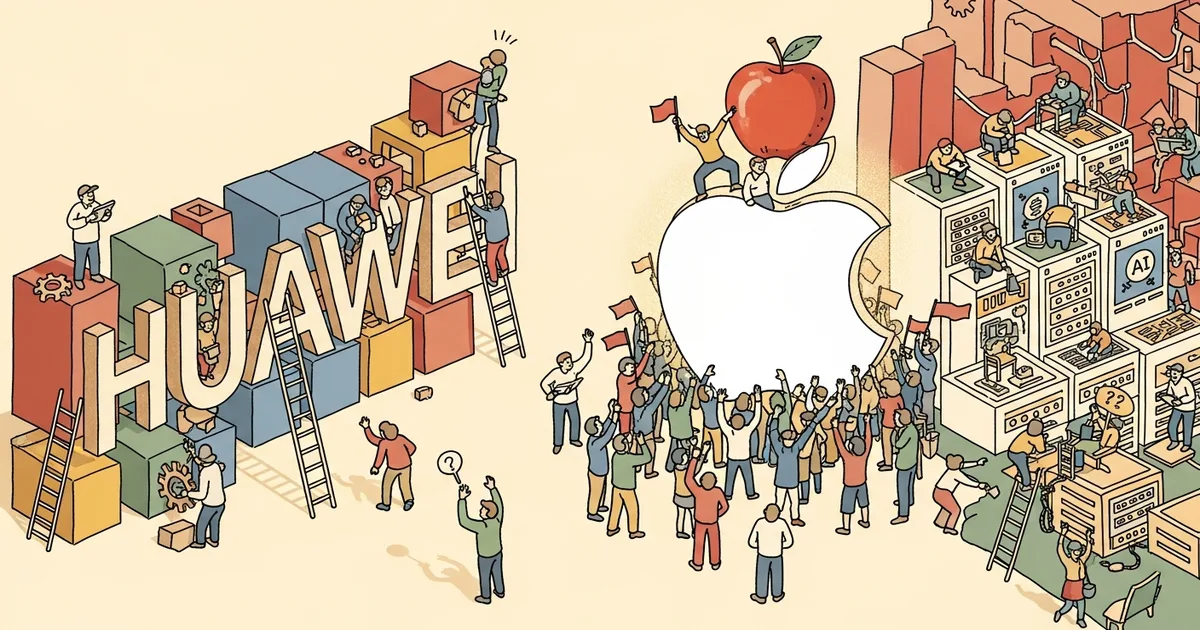
Huawei Technologies Co.’s growth decelerated sharply after Apple Inc.’s iPhone 17 made significant headway in China and domestic challengers emerged in AI chipmaking, Bloomberg reported on March 31, 2026. Huawei’s full-year 2025 revenue rose just 2.2 percent to 880.9 billion yuan ($126 billion), a dramatic slowdown from approximately 22 percent growth the year before.
The company narrowly claimed the annual smartphone championship in China for 2025, shipping 46.7 million units for a 16.4 percent market share, according to IDC. Apple finished just behind at 46.2 million units and 16.2 percent share, a gap of roughly 500,000 units. But Apple’s momentum accelerated through the year: its Q4 2025 shipments surged 28 percent year-over-year, giving it 21.8 percent market share in that quarter alone.
Why It Matters
Huawei’s resurgence over the past two years was one of the most watched stories in global technology. After U.S. sanctions cut the company off from advanced chip manufacturing, Huawei engineered a comeback through its Mate 60 and Mate 70 series using domestically produced processors. That trajectory has now stalled on two fronts: Apple’s competitive response in smartphones and Huawei’s inability to maintain growth in its cloud and AI businesses.
The smartphone battle is particularly significant because China is the world’s largest smartphone market and the only major market where Huawei competes directly with Apple. The two companies have been trading the top position through early 2026, with Huawei holding 18.3 percent of activated units and Apple at 18.2 percent as of mid-February, according to market trackers.
Technical Details
Apple’s iPhone 17, launched in late 2025, incorporated localized marketing strategies and feature enhancements tailored for Chinese consumers that drove the sales surge. Huawei’s Ascend 920 AI processor, part of its push into data center hardware, delivered a 10 percent improvement in floating-point operations per second (FLOPS) over its predecessor in internal benchmarks, but new domestic competitors have narrowed Huawei’s advantage in AI hardware.
Huawei’s cloud computing revenue also declined in 2025, as CNBC reported, reflecting the broader challenge that Chinese AI capabilities have lagged U.S. rivals in model performance and ecosystem development. This adds a second pressure point beyond smartphones: Huawei’s strategy of offsetting consumer device competition with enterprise AI infrastructure revenue has not delivered as expected.
Who’s Affected
The competitive dynamics affect the entire Chinese smartphone ecosystem. Xiaomi, OPPO, and Vivo compete below the Huawei-Apple duopoly, and shifts at the top ripple through pricing and positioning for all players. Analyst Ming-Chi Kuo has suggested Huawei may need to recalibrate its smartphone strategy and further differentiate its AI offerings to regain momentum.
In AI chips, new entrants like Shenzhen-based Horizon Robotics have secured contracts for edge computing accelerators, diversifying the supply chain for AI components within China and reducing Huawei’s ability to dominate that segment. The fragmentation makes it harder for any single Chinese company to build the kind of vertically integrated AI ecosystem that NVIDIA has constructed globally.
What’s Next
Huawei’s full quarterly financial statements for Q1 2026 are expected in late April and will reveal whether the growth stall is accelerating or stabilizing. Industry observers expect Huawei to double down on its software ecosystem and cloud services to create differentiation that hardware specifications alone cannot provide. Whether that strategy can offset Apple’s renewed consumer appeal remains the central question for the remainder of 2026.
The company’s ability to maintain momentum in AI chips faces an additional constraint: U.S. export controls continue to limit Huawei’s access to advanced semiconductor manufacturing processes, forcing reliance on domestic foundries that trail TSMC by at least one process generation. This gap affects both the performance ceiling of Huawei’s Ascend processors and the company’s ability to compete for enterprise AI infrastructure contracts against NVIDIA-powered alternatives available to Chinese cloud providers.