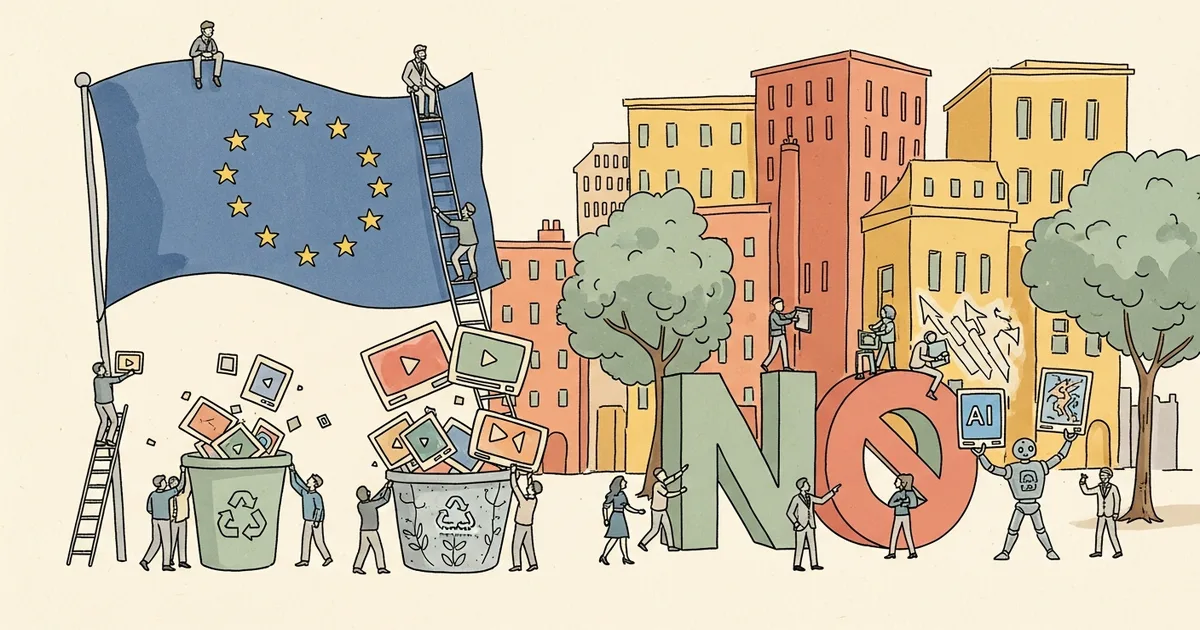
- The European Commission, Parliament, and Council have barred their press teams from using fully AI-generated videos and images in official communications, according to Politico.
- AI may still be used to optimize existing visual material, such as enhancing image quality, but not to create content from scratch.
- Commission spokesperson Thomas Regnier cited “authenticity” and “citizens’ trust” as the rationale for the policy.
- Experts criticized the blanket ban as a missed opportunity to demonstrate responsible, transparent AI use under the EU’s own AI Act labeling requirements.
What Happened
The three main EU institutions—the European Commission, Parliament, and Council—have banned their staff from using fully AI-generated videos and images in official communications. The policy, reported by Politico and covered by The Decoder on April 1, 2026, allows AI to be used only for optimizing existing footage, such as improving image quality, but prohibits generating new visual content with AI tools.
Commission spokesperson Thomas Regnier told Politico that “authenticity” is a priority in order to “foster citizens’ trust.” The European Parliament separately issued guidelines for its staff on using generative AI tools, “emphasizing vigilance regarding inherent risks.”
Why It Matters
The EU’s decision creates a sharp contrast with political communication practices elsewhere. According to the Poynter Institute, US President Donald Trump has used AI-generated content in 36 posts on his Truth Social account since his inauguration, including an image of himself as the pope and an AI-generated video about Gaza. Within the EU itself, German Chancellor Friedrich Merz posted a deepfake dancing video of himself on Instagram to discuss AI risks, and Hungary’s prime minister has used deepfake videos to attack Brussels.
The ban is notable because the EU’s own AI Act requires that AI-generated content be watermarked and labeled. By banning AI-generated content outright rather than using it with proper labeling, the EU institutions are applying a stricter standard to themselves than their legislation requires of others.
Technical Details
The policy applies specifically to the communications teams of the three institutions and covers AI-generated visual content—images and videos created entirely by AI systems. Text generated by AI was not explicitly addressed in the Politico report. The distinction between “fully AI-generated” content and AI-optimized content creates a gray area: modern image editing tools increasingly incorporate AI features, making it difficult to draw a bright line between enhancement and generation.
The EU’s AI Act, which entered into force in stages starting in 2024, establishes labeling and transparency requirements for AI-generated content. Article 50 of the Act specifically requires that AI-generated or manipulated content be marked in a machine-readable way. The institutions’ internal ban goes beyond these requirements by prohibiting the content entirely rather than simply labeling it.
Who’s Affected
EU institutional communications teams are directly affected, losing access to AI image and video generation tools that could speed content production. AI companies including Midjourney, Runway, and Synthesia that market to government clients lose a potential reference customer. Alexandru Voica from UK-based video generator Synthesia told Politico that the ban undermines the EU’s ability to respond quickly to geopolitical crises.
What’s Next
Walter Pasquarelli, an adviser to the OECD who researches AI-generated content at the University of Cambridge, told Politico that “responsible use beats abstinence” and accused the EU of “missing a leadership opportunity to demonstrate what responsible, transparent use of AI in political communication actually looks like.” The policy may face pressure to evolve as AI-assisted content creation becomes standard practice across government communications worldwide. Whether EU member states adopt similar internal bans or take a more permissive approach under the AI Act’s labeling framework remains an open question.